


Gone are the days when companies would either have their own office space or would take it on rent. These days, the concept of coworking spaces has taken over. The biggest reason is the difference in cost. The expenses related to traditional office space in India depend on various factors like location, size of the space, and infrastructure.
The cost of renting a bare shell traditional office space in cities like Mumbai, Delhi, Bengaluru is between INR 80 to INR 250 per square feet, approximately. Add to it the cost of furnishing, maintenance, electricity, office boys, security, air-conditioning, power back-up, electronics, insurance, admin manpower, office supplies like tea & coffee, mineral water etc would be around INR 60 per square feet. Overall cost of running a traditional office will be INR 140 to INR 310 per square feet. Assuming occupants are sitting with a density of 70 square feet per person, this works out to be INR 9,800 to INR 21,700 per seat (or per person) per month.
💡 Are you looking for Coworking space in Gurgaon, Noida or Delhi?. We are just a call away.
Call now: 08999 828282
Talking about coworking spaces in India, the cost is far more affordable. Most coworking operators charge you on a cost per seat basis that removes all the hard and tedious calculations. The cost per seat in a coworking space ranges between INR 8,000 to 14,000 per seat per month. Thus there is a cost saving in access of 20% merely by switching from a traditional office to a coworking space.
Cost is often one of the basic factors for businesses when it is about choosing between a coworking space and a traditional office. Here we listed out some factors that help in differentiating the expenses between traditional office and coworking office as mentioned below:-
Cost Comparison Between Traditional Offices & Coworking Spaces in India
1. Monthly Rent
Coworking spaces usually charge a monthly fee for shared workspaces and common areas. Traditional offices often have a higher monthly rent for a private office or workspace (as explained above).
2. Utilities
In a traditional office, utilities like electricity, internet, and phone services are often an additional cost, whereas, in a coworking space, these utilities are typically included in the monthly fee.
3. Maintenance
In a traditional office, maintenance cost is charged separately. However, in most coworking spaces, these services are included.
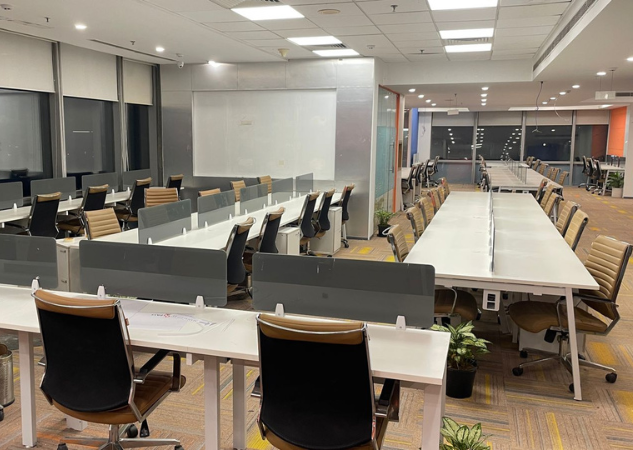
4. Equipment
While setting up a traditional office space, office equipment needs to be purchased; while these items are available on rent in a coworking space.
5. Amenities
Coworking spaces often offer a range of amenities such as meeting rooms, printing facilities, coffee and snack areas, and event spaces, which are usually included in the monthly fee.
Also Read: Top Pros and Cons of Adding Your Coworkers on Social Media
6. Location
The location of a coworking space can affect its cost, with more desirable locations usually having higher monthly fees. Traditional offices may also be more expensive in prime locations.
7. Flexibility
Coworking spaces offer more flexibility than traditional offices, such as the ability to scale up or down the amount of workspace needed, or the ability to change locations. The duration of the lock-in period in a coworking space is 12-18 months whereas in a traditional office the lock-in is usually 3 years.
8. Community
Coworking spaces offer a sense of community and networking opportunities, whereas traditional offices may not. The cost of the community aspect should be considered when comparing the two options.
💡 SMBs looking for HR, Marketing, Technology and Funding solutions for their business.
Call Hello Jarvis 994 8000 800
Thus, coworking spaces are generally more economical as compared to traditional office spaces in India. However, it is important to consider factors such as the type of infrastructure, location, and amenities offered, before taking the final call.
While you are looking for a coworking space in Delhi NCR, you can sneak peek at the benefits that The Office Pass (TOP) offers. To discuss this at length, you can call us at 08999 828282.
FREQUENTLY ASKED QUESTIONS (FAQS):
Question: Are coworking spaces more cost-effective than traditional offices?
Answer: Yes, coworking spaces are often more cost-effective because they include utilities, internet, maintenance, furniture, and shared amenities in a single membership fee. Traditional offices usually require additional expenses for setup, operations, and long-term leases.
Question: What hidden costs should businesses consider when renting a traditional office?
Answer: Traditional offices may involve hidden costs such as security deposits, interior fit-outs, furniture purchases, utility bills, maintenance charges, internet installation, housekeeping, and property taxes, depending on the lease agreement.
Question: How do lease commitments differ between coworking spaces and traditional offices?
Answer: Coworking spaces typically offer flexible membership plans ranging from daily to monthly terms, while traditional offices often require long-term lease commitments, usually spanning several years, which can reduce business flexibility.
Question: Which option is better for startups and small businesses: coworking spaces or traditional offices?
Answer: Coworking spaces are generally better for startups and small businesses because they require lower upfront investment, provide flexible scaling options, and eliminate many operational costs associated with managing a traditional office.
Question: Can coworking spaces help reduce overall business expenses?
Answer: Yes, coworking spaces can significantly reduce overall business expenses by sharing infrastructure, meeting rooms, office equipment, and support services among multiple companies, helping businesses avoid large capital and operational expenditures.