
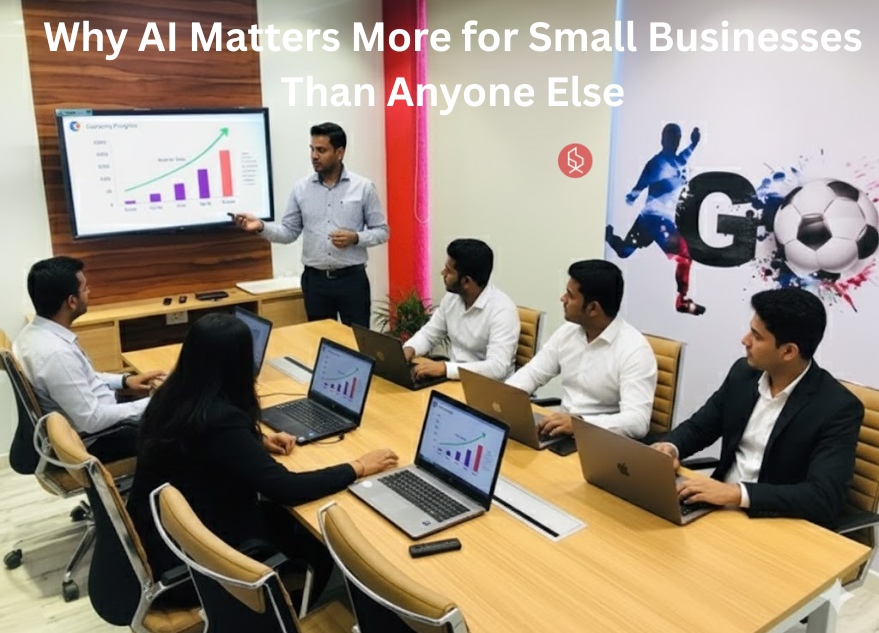
AI is no longer just for tech giants. Small businesses can use artificial intelligence to automate tasks, improve customer experiences, reduce costs, and compete more effectively with larger companies.
💡 Are you looking for Coworking space in Gurgaon, Noida or Delhi? We are just a call away. Call Now: 08999 828282
10 Ways Small Businesses Can Harness AI to Boost Profits
- AI for Small Businesses: The Great Equalizer in Modern Commerce
- Cost Efficiency: Doing More with Limited Resources
- Customer Experience Enhancement Through Intelligent Automation
- Data-Driven Decision Making Without the Data Science Degree
- Marketing That Actually Reaches Your Target Audience
- Competitive Intelligence and Market Positioning
- Scaling Operations Without Proportional Cost Increases
- Risk Management and Fraud Prevention
- Employee Productivity and Workflow Optimization
- Future-Proofing Your Business Model
1. AI for Small Businesses: The Great Equalizer in Modern Commerce
The best ai for small business applications transforms how entrepreneurs compete in crowded markets. Unlike large corporations that need complex systems, small businesses can implement streamlined AI solutions that deliver immediate results. These tools automate repetitive tasks, analyze customer behavior, and provide insights that previously required entire departments. Moreover, cloud-based AI platforms have made enterprise-level capabilities accessible at affordable price points.

2. Cost Efficiency: Doing More with Limited Resources
AI software for small business operations dramatically reduces overhead while boosting productivity. A single entrepreneur can now handle customer service inquiries 24/7 through chatbots, schedule social media posts intelligently, and manage inventory with predictive analytics. These automated processes free up time and budget, allowing them to be redirected to strategic growth initiatives. For businesses operating on tight margins, this efficiency translates directly into competitive advantage and profitability.
3. Customer Experience Enhancement Through Intelligent Automation
Using ai in small business settings revolutionizes how you connect with customers. Personalized product recommendations, instant response times, and predictive support systems create memorable experiences that build loyalty. AI analyzes purchasing patterns to anticipate needs before customers even express them. This level of sophistication, once exclusive to major retailers, now helps local shops compete effectively and retain their customer base.
Also Read: The Top 10 Ways Small Businesses Can Make Money In 2026
4. Data-Driven Decision Making Without the Data Science Degree
Artificial intelligence small business opportunities emerge when entrepreneurs gain access to actionable insights from their data. Modern AI tools translate complex analytics into clear recommendations about pricing strategies, marketing campaigns, and inventory management. You don’t need statistical expertise to understand which products to stock or when to launch promotions. The technology handles the heavy lifting, presenting findings in straightforward dashboards that inform smarter business decisions.
5. Marketing That Actually Reaches Your Target Audience
AI in small business marketing transforms how you connect with potential customers online. Machine learning algorithms optimize ad spend by identifying which audiences convert best and adjusting campaigns in real time. Content creation tools help generate engaging social media posts and email campaigns tailored to different customer segments. This precision targeting ensures every marketing dollar works harder, delivering better ROI than traditional trial-and-error approaches.
6. Competitive Intelligence and Market Positioning
AI for SMB owners provides unprecedented visibility into competitive landscapes and emerging market trends. Sentiment analysis tools monitor what customers say about your competitors, revealing gaps you can exploit. Pricing algorithms help you stay competitive without sacrificing margins by dynamically analyzing market conditions. This intelligence gathering happens automatically, giving you strategic advantages without requiring dedicated research teams or expensive consultants.
7. Scaling Operations Without Proportional Cost Increases
Traditional business growth meant hiring more staff and expanding infrastructure proportionally. However, the best AI for small business operations breaks this linear relationship between growth and expenses. Automated workflows handle increased transaction volumes, customer inquiries, and administrative tasks without additional headcount. This scalability allows small businesses to grow revenue while maintaining lean operations, improving profitability margins that typically shrink during expansion phases.
8. Risk Management and Fraud Prevention
AI software for small business security identifies potential threats before they impact your bottom line. Transaction monitoring systems flag unusual patterns that may indicate fraud, while predictive models assess credit risk to extend payment terms. AI-powered cybersecurity tools detect vulnerabilities and respond to threats faster than humans can. These protective measures safeguard your assets and reputation without requiring dedicated security personnel.
💡 Are you looking for Coworking space in Gurgaon, Noida or Delhi? We are just a call away. Call Now: 08999 828282
9. Employee Productivity and Workflow Optimization
Using AI in small business operations empowers your team to focus on high-value activities. Routine data entry, scheduling, report generation, and document processing happen automatically through intelligent automation. Employees gain AI-powered assistants that help them work faster and make fewer errors. This productivity boost enables your existing team to accomplish more without burnout, improving job satisfaction and driving business results.
10. Future-Proofing Your Business Model
Artificial intelligence presents small-business opportunities that extend beyond current operations to long-term viability. Early adopters develop competitive advantages that compound over time as they accumulate more data and refine their AI systems. Businesses that delay AI integration risk falling behind competitors who deliver faster, more personalized, and more efficient services. Investing in AI for smb growth today positions your business to adapt quickly as technology continues evolving and customer expectations rise.
Conclusion
The transformative power of AI for small businesses can’t be ignored anymore. It levels the playing field, giving growing companies access to tools that were once reserved for large enterprises. From streamlining daily operations to improving customer engagement, the right AI software for small businesses delivers real, measurable impact on profitability. The real question isn’t if you should adopt AI, but how soon you can do it effectively. The Office Pass (TOP) makes this transition simple by helping small businesses identify, implement, and scale the best AI solutions for their needs. To get started and future-proof your business, connect with The Office Pass (TOP) today at +91-8999-828282 and take the first step toward smarter, sustainable growth.
FREQUENTLY ASKED QUESTIONS (FAQS):
Question: What is the best AI for small business owners just getting started?
Answer: Customer service chatbots and email marketing automation tools offer the easiest entry points. These require minimal technical knowledge, integrate quickly with existing systems, and deliver immediate time savings and improved customer engagement.
Question: How much does AI software for small business typically cost?
Answer: Most AI tools for small businesses range from free tiers to $50-200 monthly for premium features. Cloud-based subscription models eliminate large upfront investments, making enterprise-level AI accessible even on limited budgets.
Question: Can AI in small businesses replace human employees?
Answer: AI complements rather than replaces human workers by handling repetitive tasks and data analysis. This frees employees to focus on creative problem-solving, relationship building, and strategic work that requires human judgment and empathy.
Question: What are the biggest artificial intelligence small business opportunities in 2026?
Answer: Personalized customer experiences, predictive inventory management, and automated content creation represent the highest-impact opportunities. These applications directly address common small business challenges while requiring relatively simple implementation.
Question: Is using AI in small businesses complicated for non-technical owners?
Answer: Modern AI tools feature intuitive interfaces designed specifically for non-technical users. Most platforms offer templates, tutorials, and customer support that make implementation straightforward, even without programming or data science backgrounds.
Question: How quickly can AI for SMB operations show measurable results?
Answer: Many businesses see improvements within weeks of implementation. Chatbots reduce response times immediately, while marketing automation and analytics typically demonstrate ROI within the first 1-3 months of consistent use.
Question: What security concerns should small businesses consider with AI software?
Answer: Choose reputable providers with strong data encryption, compliance certifications, and transparent privacy policies. Regularly update systems, train employees on security best practices, and monitor access controls to protect sensitive business information.
Question: Can AI help small businesses compete with larger corporations?
Answer: Absolutely—AI levels the playing field by providing small businesses with analytical capabilities, automation, and customer insights previously available only to enterprises with massive IT departments and budgets.
Question: What’s the first step in implementing AI for small businesses?
Answer: Identify your biggest operational pain points or time-consuming tasks. Research AI tools specifically designed to address those challenges, then start with one solution and expand as you become comfortable with the technology.
Question: Do I need special training to use the best AI for small business applications?
Answer: Most modern AI platforms require no specialized training beyond basic computer skills. Providers typically offer onboarding support, video tutorials, and responsive customer service to help users maximize their investment quickly and effectively.