

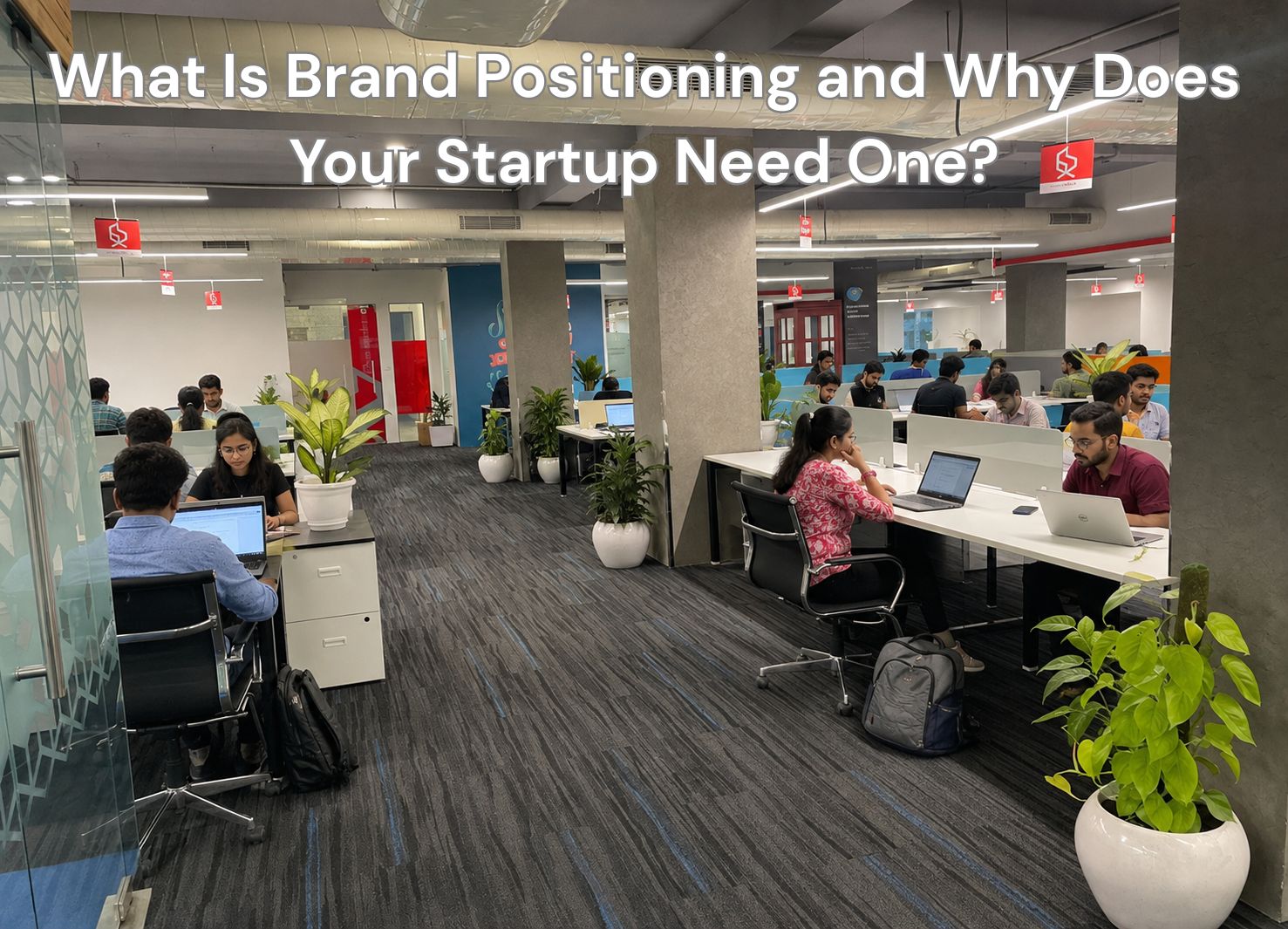
You’re sharing a coworking floor with a dozen other founders — a D2C skincare startup at the next desk, a SaaS team by the window, a fintech app team near the coffee machine. All of you are building something. But ask yourself: if a customer had to describe your brand in one sentence, would they get it right?
That’s the problem brand positioning solves.
What Is Brand Positioning?
Brand positioning is the strategic process of defining how your brand is perceived in the mind of your target customer relative to competitors. It’s not your logo, tagline, or color palette — it’s the specific, defensible space your brand occupies in a crowded market.
In simple terms: brand positioning in marketing answers one question — “Why should someone choose you over the next founder’s startup in this very coworking space?”
A strong position is built on three pillars:
- Who you serve (your specific target audience)
- What you offer that’s genuinely different (your unique value)
- Why it matters to that audience (the benefit they can’t get elsewhere)
💡 Are you looking for Coworking space in Gurgaon, Noida or Delhi?. We are just a call away.
Call now: 08999 828282
What You are Really Looking For?
Most people searching “brand positioning” fall into a few buckets, and this guide is built to answer all of them:
| Intent Type | What You Want? | Where We Cover It? |
| Informational | A clear definition and concept explanation | Sections 1–2 |
| Commercial investigation | Comparing frameworks/models before choosing one | Section 4 |
| Transactional/how-to | A step-by-step process to build your own | Section 5 |
| Validation | Proof it’s worth the time for an early-stage startup | Section 3 |
If you’re a solo founder or small team working out of a coworking space, you likely don’t have a big marketing department. You need something practical you can execute this week — not a 40-page brand book. That’s the gap most existing articles miss, and it’s the gap this one fills.

Why Coworking-Based Startups Especially Need Brand Positioning?
Coworking spaces compress competition into physical proximity. Unlike a startup working from a private office, you’re constantly being compared — in elevator pitches, community Slack channels, networking events, and demo days held right inside the coworking hub. Your positioning gets tested daily, whether you’ve defined it or not.
The Importance of Brand Positioning for Early-Stage Startups
- Faster investor and customer clarity — Investors meeting 15 pitches a week remember startups with a sharp position, not vague ones.
- Lower customer acquisition cost — Clear positioning means your marketing message resonates on the first impression, reducing wasted ad spend.
- Pricing power — A well-positioned brand can justify premium pricing because value is clearly communicated, not just features.
- Team alignment — Everyone from your intern to your co-founder pitches the company the same way.
- Resilience against copycats — When positioning is tied to genuine value (not just marketing language), it’s harder for competitors to replicate.
Benefits of Brand Positioning in Numbers
Position and consistent branding compound. Companies that maintain brand consistency across all channels have been shown to see meaningfully higher revenue growth than those with inconsistent branding — a gap that widens further when messaging, visuals, and tone are all aligned to one clear position. For a startup, that consistency starts with positioning, not design.
Brand Positioning Framework and Models Compared
There’s no single “correct” brand positioning model — the right one depends on your stage and market. Here’s a comparison of the frameworks startups actually use:
| Framework | Best For | Core Question It Answers |
| Value Proposition Canvas | Product-market fit stage | Does our offer match real customer pain points? |
| Perceptual Mapping | Competitive markets (e.g., D2C, SaaS) | Where do we sit vs. competitors on price/quality axes? |
| Brand Positioning Statement (Kapferer/Classic) | Any startup needing a single source of truth | Who, what, why, and how are we different? |
| StoryBrand/Narrative Model | Brands leading with storytelling and content | What transformation do we offer the customer? |
Most early-stage startups get the best ROI from combining a perceptual map (to see the competitive gap) with a classic positioning statement (to write it down clearly).
💡 Are you looking for Coworking space in Gurgaon, Noida or Delhi?. We are just a call away.
Call now: 08999 828282
How to Write a Brand Positioning Statement?
A brand positioning statement is a short internal document — usually 1–2 sentences — that defines your position for your whole team to align around.
Template:
For [target customer], [brand name] is the [category/frame of reference] that [key differentiator/benefit], because [reason to believe].
Example (coworking-space food-tech startup):
For busy tech professionals in coworking hubs, TiffinBox is the subscription meal service that delivers home-style regional food in under 20 minutes, because we partner directly with local home chefs instead of large commercial kitchens.
Notice this statement is internal-facing — it’s not your tagline. Your public marketing language will be adapted from this, but the statement itself should stay precise and unpolished.
The Brand Positioning Process: A Step-by-Step Guide
Here’s a practical brand positioning process you can run in a single working session, even from a coworking meeting room:
- Map your competitors. List 5–8 direct and indirect competitors. Note their claimed positioning (check the homepage headline on their website).
- Identify your target customer’s core problem. Talk to 5 real customers — not assumptions. Coworking communities are useful here; your neighbors are often your first honest focus group.
- Find the gap. Where are competitors weak, generic, or absent? That’s your opening.
- Draft your positioning statement. Use the template above.
- Pressure-test it. Ask: Could a competitor make the exact same claim? If yes, it’s not specific enough — go back to step 3.
- Translate it into messaging. Turn the internal statement into a public-facing tagline, website copy, and pitch line.
- Audit consistency. Check your website, social bios, pitch deck, and signage (including your desk signage in the coworking space) all reflect the same position.
A Note From Practice
Founders often confuse positioning with differentiation. Differentiation is what makes you different (features, price, speed). Positioning is how that difference is perceived by the customer. A startup can have real differentiation and still lose the market because nobody understands or remembers it. Positioning is the bridge between the two.
Effective and Successful Brand Positioning: What the Data-Backed Examples Show
Effective brand positioning tends to share three traits, visible across successful Indian startups that scaled out of small teams and shared workspaces:
- Specificity over breadth — Narrowing the target audience (rather than trying to serve “everyone”) consistently produces stronger brand recall.
- Consistency across every touchpoint — from pitch deck to product packaging to social media bio.
- A position rooted in a real, provable strength — not an aspirational claim the product can’t back up.
Common Mistakes Startups Make With Brand Positioning
- Copying a competitor’s tone instead of finding a genuine gap
- Writing positioning statements that could apply to any company in the category
- Treating positioning as a one-time task instead of revisiting it as the market shifts
- Confusing positioning with visual branding (logo, colors) — visuals should follow positioning, not replace it
💡 Are you looking for Coworking space in Gurgaon, Noida or Delhi?. We are just a call away.
Call now: 08999 828282
Key Takeaways
- Brand positioning defines how your target customer perceives you relative to competitors — it’s strategic, not cosmetic.
- It directly impacts customer acquisition cost, pricing power, and investor clarity for startups.
- Use a positioning statement template (Who, What, Why) to align your team internally before writing public marketing copy.
- Choose a framework — perceptual mapping and the classic positioning statement work well together for early-stage startups.
- Revisit your positioning as your market, competitors, and audience evolve — it’s a living strategy, not a one-time exercise.
Conclusion
Your coworking space is full of founders solving different problems the same way — with hustle and hope. The ones who scale are usually the ones who can also explain, in one clear sentence, exactly why they’re different. Start there.
Strong brand positioning helps a startup stand out, communicate its value clearly, and build lasting customer trust. But a strong brand also needs the right environment to grow. A professional The Office Pass (TOP) coworking space gives startups a flexible, well-equipped workspace where teams can collaborate, meet clients, and stay focused without the cost of a traditional office. If you’re ready to give your startup a workspace that supports growth, Contact TOP at +91-8999-828282.
FREQUENTLY ASKED QUESTIONS (FAQS):
Question: What is brand positioning in simple words?
Answer: Brand positioning is the specific place your brand occupies in a customer’s mind compared to competitors — built around who you serve, what makes you different, and why that difference matters.
Question: What is the difference between brand positioning and brand strategy?
Answer: Brand positioning defines where you sit in the market. Brand strategy is the broader plan — including positioning, messaging, visual identity, and channels — for building and growing the brand over time.
Question: How long should a brand positioning statement be?
Answer: One to two sentences. It’s an internal alignment tool, not public marketing copy.
Question: Does a small startup really need brand positioning, or just big companies?
Answer: Small and early-stage startups arguably need it more, since they have limited marketing budgets and can’t outspend competitors — clear positioning helps them compete on clarity instead of budget.
Question: How often should brand positioning be reviewed?
Answer: Review it whenever there’s a major shift: new competitors entering the market, a pivot in the target audience, or a significant product change. Many startups revisit positioning every 12–18 months even without major shifts, simply to stay aligned with market perception.