

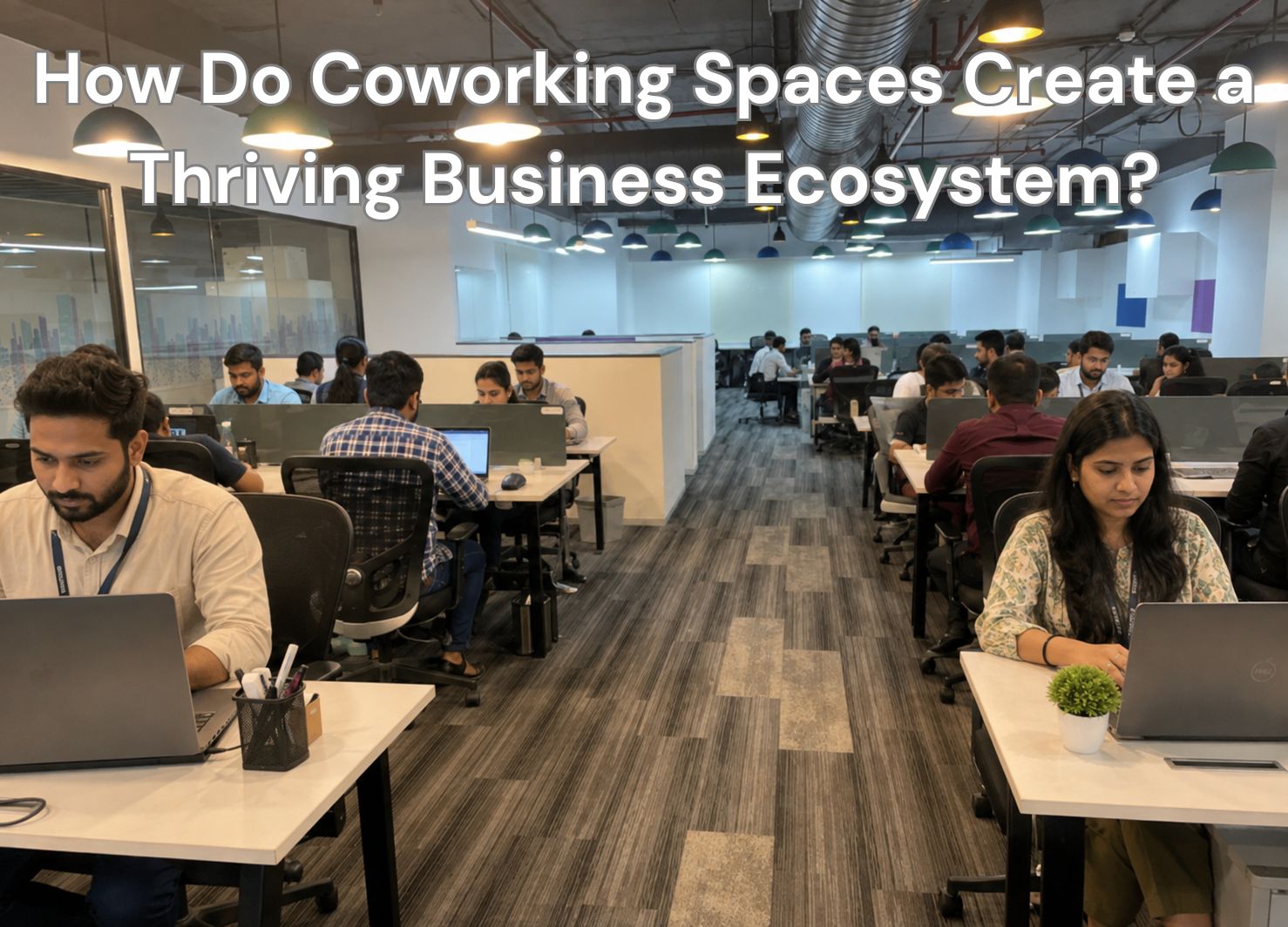
A business ecosystem is a network of interconnected companies, freelancers, investors, and service providers that grow together by sharing resources, knowledge, and opportunities. Coworking spaces in India have become the physical and digital hubs where this happens — bringing startups, MSMEs, remote teams, and mentors under one roof so that collaboration replaces isolation. For coworking users, this means faster access to clients, talent, funding conversations, and skills, without the overhead of building these networks alone.
What Is a Business Ecosystem?
A business ecosystem is a community of interacting organizations and individuals — startups, vendors, customers, investors, and institutions — whose combined activity creates more value than any single player could generate alone. The term, popularized by strategist James F. Moore in the 1990s, borrows from biology: just as species co-evolve in a habitat, businesses co-evolve within shared markets, platforms, and physical spaces.
In India’s coworking context, this ecosystem is compressed into a single building or campus. A SaaS founder, a chartered accountant, a design freelancer, and a venture scout might share the same coffee counter — and that proximity is the entire point.
💡 Are you looking for Coworking space in Gurgaon, Noida or Delhi?. We are just a call away.
Call now: 08999 828282
Why Coworking Spaces Are Natural Business Ecosystems?
Traditional office leases isolate a company behind its own four walls. Coworking spaces do the opposite by design.
- Shared physical proximity turns hallway chats into partnerships, referrals, and hires.
- Curated tenant mix — many Indian operators deliberately balance startups, freelancers, and enterprise satellite teams to create diversity of skill and demand.
- Built-in events and demo days manufacture the “random collisions” that organic office environments rarely produce.
- Shared infrastructure (meeting rooms, legal/HR desks, printers, high-speed internet) lowers the cost of doing business, freeing time for relationship-building instead of admin.
Real-world example: A two-person fintech startup at a Bengaluru coworking space landed its first enterprise pilot not through cold outreach, but because a fellow member — a mid-sized NBFC’s regional head — happened to work from the same floor. This kind of unplanned but high-value connection is the defining trait of a healthy ecosystem.
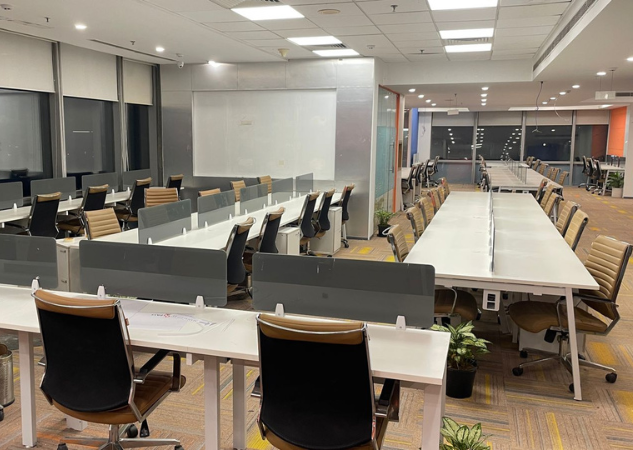
Types of Business Ecosystem in Coworking Environments
Not all coworking ecosystems function the same way. Understanding the type helps you choose the right space for your goals.
| Ecosystem Type | Core Composition | Best For |
| Startup-driven ecosystem | Early-stage founders, angel investors, accelerators | Fundraising, MVP validation, hiring first employees |
| Freelancer/creator ecosystem | Designers, writers, developers, consultants | Referral networks, skill-sharing, project collaboration |
| Enterprise satellite ecosystem | Corporate teams, GCCs, mid-market firms | Vendor access, talent pipelines, brand credibility |
| Sector-specific ecosystem | Fintech, healthtech, or D2C-focused hubs | Industry-specific partnerships, niche investor access |
| Hybrid/mixed-use ecosystem | Combination of the above | Broad networking, flexibility as business scales |
Most large Indian coworking chains operate hybrid ecosystems, while newer sector-focused hubs (like fintech-only spaces in Mumbai or biotech clusters in Hyderabad) are gaining traction for founders who want deeper, narrower networks.
Also Read: 10 Ways Startups Can Increase Their Visibility
Business Ecosystem Development: How It Happens Inside a Coworking Space
Business ecosystem development refers to the deliberate process of growing connections, capabilities, and shared value within a network over time — not a one-time event.
Inside coworking spaces, development typically follows this sequence:
- Onboarding and visibility — new members are introduced at community events or via internal directories/apps.
- Trust-building through proximity — repeated informal interactions (lunch, common areas) build familiarity before formal business ever happens.
- Structured programming — panel discussions, investor meetups, and skill workshops accelerate connections that would otherwise take months.
- Cross-referrals — members recommend each other to clients, vendors, or hires, compounding trust across the network.
- Community-led governance — active member communities (WhatsApp/Slack groups, resident mentors) sustain engagement between formal events.
Practical tip: Ecosystem development doesn’t happen automatically just by renting a desk. Members who attend at least one community event weekly report meaningfully more partnership and referral opportunities than those who work in isolation, even within the same building.
Business Ecosystem Strategy: How to Actively Benefit as a Coworking User
A business ecosystem strategy is your personal or company-level plan to extract maximum value from the network around you, rather than waiting for opportunities to arrive.
Steps coworking users should follow:
- Map the community. Ask the space manager for a member directory or LinkedIn group; identify 5–10 people whose businesses complement yours.
- Give before you ask. Offer expertise, introductions, or feedback first — ecosystems reward contributors, not just consumers.
- Attend curated events selectively. Prioritize sessions relevant to your growth stage (fundraising talks for early founders, tax/compliance sessions for freelancers).
- Use the space’s digital community tools. Most Indian operators now run app-based communities (e.g., internal Slack, member apps) — treat these as a CRM for relationship-building.
- Track outcomes. Note which connections convert into clients, hires, or collaborators, and double down on those channels.
Business Ecosystem Management: Sustaining Value Over Time
Business ecosystem management is the ongoing effort — usually led by the coworking operator, but partly owned by members — to keep the network healthy, balanced, and mutually beneficial.
Well-managed ecosystems typically show:
- Diversity without dilution — enough variety of businesses to enable cross-referrals, but enough density in key sectors to create real expertise clusters.
- Active community management — a dedicated community manager who facilitates introductions rather than just enforcing space rules.
- Feedback loops — regular member surveys that shape future events and tenant curation.
- Churn awareness — operators who track why members leave often uncover ecosystem gaps (e.g., lack of mentorship for scaling founders) faster than competitors.
Industry best practice: Leading Indian coworking operators increasingly measure “community health” metrics — event attendance, intra-member referrals, and member retention — alongside occupancy rates, recognizing that ecosystem strength directly drives renewal decisions.
What Most Articles on This Topic Miss?
Many existing guides describe coworking ecosystems in abstract, aspirational terms — “collaboration,” “synergy,” “innovation” — without addressing the practical friction points users actually face:
- Not every coworking space has an equally strong ecosystem. Location, tenant curation, and community management quality vary enormously, even within the same brand.
- Ecosystems can suffer from over-saturation — too many businesses in the same niche compete rather than collaborate.
- Passive membership yields little. Simply having a desk does not create ecosystem value; active participation does.
- Ecosystem value is measurable, not just anecdotal — tracking referral sources and event ROI helps users choose (or negotiate with) the right space.
💡 Are you looking for Coworking space in Gurgaon, Noida or Delhi?. We are just a call away.
Call now: 08999 828282
Key Takeaways
- A business ecosystem is a network of interdependent businesses that create shared value through proximity, trust, and collaboration.
- Coworking spaces accelerate ecosystem formation by combining shared infrastructure with curated community programming.
- Ecosystems come in several types — startup-driven, freelancer, enterprise, sector-specific, and hybrid — and choosing the right type matters as much as choosing the right space.
- Ecosystem development is a continuous process, not a one-time benefit of signing a membership.
- Users get the most value with a deliberate ecosystem strategy: mapping connections, contributing first, and tracking outcomes.
- Strong ecosystem management by the operator — active community facilitation and feedback loops — is what separates a thriving coworking hub from a shared office with free coffee.
Conclusion
A great workspace can do more than give your team a desk. It can put you closer to new ideas, useful connections, potential clients, and people who understand the realities of running a business. The Office Pass (TOP) brings professionals and businesses together through thoughtfully designed coworking spaces built for collaboration and growth. If you’re looking for a workspace that supports both productivity and meaningful connections, contact TOP at +91-8999-828282 and explore your options.
FREQUENTLY ASKED QUESTIONS (FAQs):
Question: What is a business ecosystem in simple terms?
Answer: It’s a group of businesses and individuals — competitors, partners, vendors, and customers — that interact and grow together within a shared environment, such as a coworking space or industry cluster.
Question: How do coworking spaces create a business ecosystem?
Answer: Coworking spaces bring diverse businesses into shared physical or digital proximity, then use events, community management, and shared infrastructure to convert that proximity into real collaboration, referrals, and partnerships.
Question: What are the main types of business ecosystem in coworking spaces?
Answer: The most common types are startup-driven, freelancer/creator, enterprise satellite, sector-specific, and hybrid ecosystems, each suited to different business goals.
Question: How can I benefit more from my coworking space’s business ecosystem?
Answer: Attend community events regularly, offer help before asking for it, use the space’s digital community tools, and track which connections actually convert into business outcomes.
Question: Do all coworking spaces offer the same ecosystem value?
Answer: No. Ecosystem strength depends on tenant mix, community management quality, and event programming — factors worth evaluating before choosing a space.