

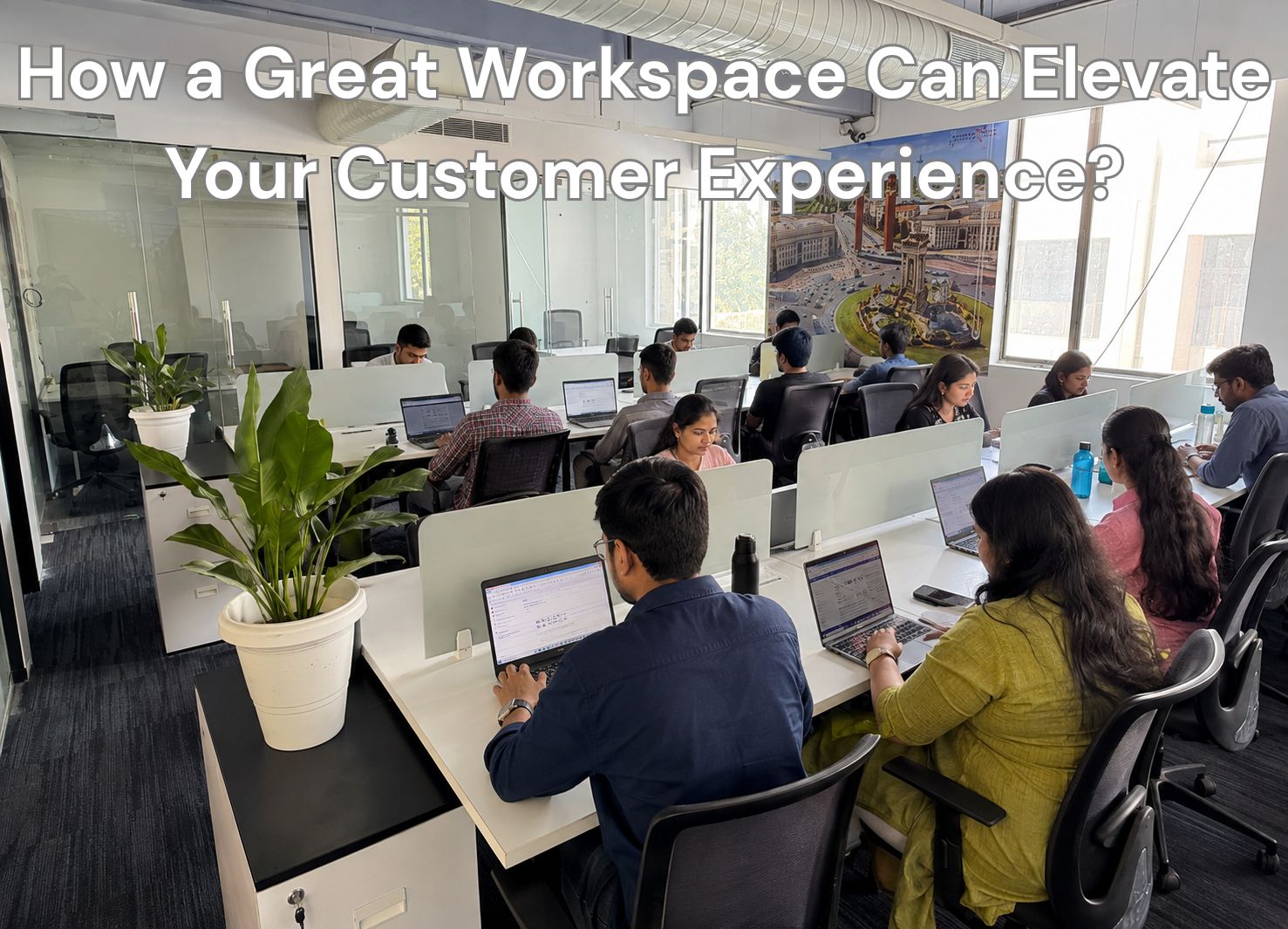
Customer experience (CX) is no longer just about call centre scripts or post-sale surveys. It starts the moment a client walks through your office door. If you run a startup, freelance practice, or client-facing team out of a coworking space in Bengaluru, Mumbai, Gurgaon, or Pune, your physical environment is quietly doing (or undoing) a lot of your CX work.
This article breaks down exactly how workspace design connects to customer experience, what most coworking guides miss, and how you can use your workspace as a genuine CX advantage.
What Is Customer Experience, Really?
Customer experience is the cumulative impression a customer forms across every interaction with your business — digital, human, and physical.
Most people equate CX with support tickets or app usability. But for service businesses, consultants, and client-facing startups operating from coworking spaces, physical environment is an under-recognised CX touchpoint. A cramped, noisy meeting room can undo weeks of relationship-building in fifteen minutes.
💡 Are you looking for Coworking space in Gurgaon, Noida or Delhi? We are just a call away. Call Now: 08999 828282
Why Workspace Quality Is Part of the Customer Experience Journey?
The customer experience journey includes every touchpoint a client has with your brand, and for many India-based service businesses, an in-person office visit is one of the highest-stakes touchpoints in that journey.
Think about the typical journey for a client evaluating a consultant, agency, or startup:
- Discovery (website, referral, LinkedIn)
- First call or email
- In-person meeting or office visit
- Proposal and negotiation
- Onboarding
- Ongoing service delivery
Step 3 is where workspace quality either reinforces or contradicts everything said in steps 1 and 2. A polished pitch delivered in a poorly lit, Wi-Fi-lagging meeting room signals inconsistency — and inconsistency is one of the top trust-killers in B2B relationships.
7 Ways a Great Workspace Elevates Customer Experience
- First Impressions Set the Trust Baseline
- Reliable Infrastructure Removes Friction
- Private Meeting Spaces Protect Confidentiality
- Ambience Influences Decision-Making
- Consistent Environment Builds Brand Reliability
- On-Site Staff Behavior Shapes Perception
- Amenities Signal Value Alignment
1. First Impressions Set the Trust Baseline
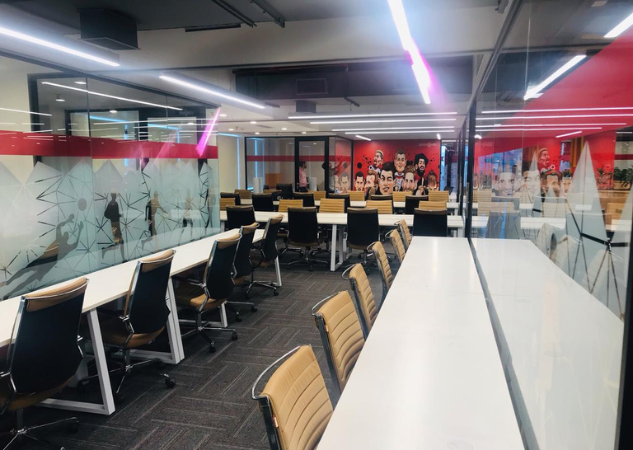
Reception quality, cleanliness, and lighting shape a visitor’s judgment within the first 30–60 seconds, well before any conversation happens.
2. Reliable Infrastructure Removes Friction
Stable high-speed internet, working AV equipment, and backup power aren’t luxuries — they’re baseline expectations. A dropped video call during a client demo is a CX failure, not a technical inconvenience.
3. Private Meeting Spaces Protect Confidentiality
Financial consultants, legal professionals, and HR service providers in particular need soundproof rooms. Discussing sensitive client information in an open coworking area is both a trust and compliance risk.
4. Ambience Influences Decision-Making
Environmental psychology research consistently shows that lighting, noise levels, and spatial comfort affect cognitive load and mood — both of which shape how receptive a client is during negotiations.
5. Consistent Environment Builds Brand Reliability
Clients who visit your coworking space multiple times over a project lifecycle notice consistency (or the lack of it). A reliably well-maintained space reinforces that your business itself is dependable.
6. On-Site Staff Behavior Shapes Perception
Front-desk and facility staff are unofficial brand ambassadors. Their tone, responsiveness, and problem-solving speed directly influence how clients perceive your professionalism, even though they aren’t your employees.
7. Amenities Signal Value Alignment
Access to good coffee, quiet zones, and well-stocked pantries seems minor, but clients read amenity quality as a proxy for how seriously your business invests in details — including how it will treat them.
Building a Customer Experience Strategy Around Your Workspace
A workspace-aware customer experience strategy treats your coworking environment as a controllable CX variable, not a fixed backdrop.
Practical framework for coworking users:
|
Strategy Element |
What to Do? |
| Pre-visit prep | Send clients a short brief: parking, floor number, Wi-Fi guest access |
| Room selection | Book meeting rooms based on client sensitivity level, not just availability |
| Staff briefing | Alert front-desk about VIP visits so they’re greeted properly |
| Post-visit follow-up | Ask directly whether the space met expectations |
| Space audit | Review your coworking plan quarterly against client feedback |
Most coworking guides stop at “pick a good location.” A real strategy treats the space as an active lever you manage, not a passive amenity you rent.
💡 Are you looking for Coworking space in Gurgaon, Noida or Delhi? We are just a call away. Call Now: 08999 828282
Customer Experience Management: What Coworking Users Often Miss
Customer experience management (CXM) requires assigning clear ownership — most coworking users never designate who is responsible for workspace-related CX, so failures go unaddressed.
Common gaps competitors’ articles rarely mention:
- No single owner: In small teams, nobody is explicitly responsible for “does our meeting room reflect our brand?”
- Reactive, not proactive: Issues (poor lighting, weak signal) get noticed only after a client mentions it.
- Disconnected from broader CX data: Workspace feedback rarely gets merged with sales or support CX metrics, so patterns go unnoticed.
- Ignoring hybrid journeys: Many client relationships mix video calls and in-person visits; inconsistent quality between the two erodes trust.
Assign one team member as the “workspace experience owner” who checks meeting rooms before major client visits and logs recurring issues with the coworking operator.
Using a Customer Experience Survey to Track Workspace Impact
A short, targeted customer experience survey sent after in-person meetings can isolate workspace-specific friction that generic CX surveys miss.
Suggested 4-question survey template:
- How would you rate the meeting environment (comfort, cleanliness, quiet)? (1–5)
- Did any technical issue (Wi-Fi, AV, calls) affect our meeting?
- How did the space compare to your expectations of our business?
- Any specific feedback about the location or facility?
Standard CX surveys ask about your product or service. Very few coworking users add a workspace-specific question — a clear, low-effort content and practice gap you can close immediately.
Choosing a Customer Experience Platform for Small Teams
For coworking-based businesses, a lightweight customer experience platform that combines feedback collection, CRM notes, and visit logs is more useful than an enterprise CX suite.
What to look for:
- Simplicity: Tools like Zoho Desk, Freshdesk, or even a structured Google Form + Sheets setup work well for small teams.
- CRM integration: Link visit feedback to the relevant client record so patterns are visible over time.
- Low setup cost: Enterprise CX platforms (Qualtrics, Medallia) are usually overkill for teams under 20 people.
- Mobile access: Front-desk or account managers should be able to log feedback immediately after a client visit, not days later.
Start with a free-tier tool and a shared spreadsheet before investing in a paid customer experience platform — most coworking-based teams overbuy tooling before they’ve established a habit of collecting feedback at all.
Customer Experience Training for On-Site Teams
Customer experience training should extend beyond your own employees to include a working relationship with your coworking space’s front-desk and facility staff.
Steps that most businesses skip:
- Brief the coworking staff on how you want VIP or first-time clients greeted.
- Share your brand tone — formal, casual, technical — so staff can match it in small interactions.
- Train your own team on a simple pre-meeting checklist: room booked, tech tested, materials printed.
- Debrief after high-stakes visits to capture what worked and what didn’t.
Many coworking operators in India (including major players) offer relationship managers for enterprise clients — but individual freelancers and small teams often don’t know they can request the same level of coordination for important meetings. Asking is usually free.
What the Best Customer Experience Coworking Spaces Do Differently?
Spaces recognised for delivering the best customer experience to their member businesses typically share these traits:
- Dedicated meeting room booking with buffer time between sessions to avoid overlap and rushed handovers
- Visible service-level commitments on Wi-Fi speed, AC maintenance, and cleaning schedules
- Trained, empowered front-desk staff who can resolve small issues without escalation delays
- Quiet zones separate from collaborative areas for confidential client conversations
- Transparent complaint resolution with visible turnaround times
Comparison snapshot:
| Factor | Average Coworking Space |
Best-in-Class Coworking Space |
| Wi-Fi reliability | Occasional drops | 99%+ uptime with backup |
| Meeting room booking | First-come-first-served | Pre-bookable with buffer slots |
| Staff training | Basic hospitality | Client-service oriented, brand-aware |
| Feedback loop | None or informal | Structured surveys, visible fixes |
| Confidentiality | Open seating only | Dedicated private/soundproof rooms |
💡 Are you looking for Coworking space in Gurgaon, Noida or Delhi? We are just a call away. Call Now: 08999 828282
Conclusion
A thoughtfully designed workspace shapes every customer interaction, from first impressions to lasting relationships. If you’re looking to create an environment that inspires confidence, improves service quality, and supports business growth, TOP Coworking offers premium, flexible workspaces across Delhi NCR. With modern amenities, collaborative environments, and professional meeting spaces, The Office Pass (TOP) helps businesses deliver exceptional customer experiences while empowering teams to perform at their best. Choose a workspace that reflects the quality of your brand. Contact TOP at+91-8999-828282 to explore flexible workspace solutions tailored to your business needs.
FREQUENTLY ASKED QUESTIONS (FAQS):
Question: Does workspace quality really affect customer experience?
Answer: Yes. Physical environment shapes first impressions, perceived professionalism, and meeting outcomes — all core components of the customer experience journey.
Question: What’s the fastest way to improve CX in a coworking space?
Answer: Start with a short post-meeting customer experience survey and brief your coworking front-desk staff before important client visits.
Question: Do I need an expensive customer experience platform?
Answer: No. Most coworking-based teams get sufficient value from lightweight tools (Freshdesk, Zoho, or structured spreadsheets) before needing enterprise CX software.
Question: How do I train coworking staff who aren’t my employees?
Answer: Share a simple briefing note before high-stakes visits covering client name, tone expectations, and any special requirements. Most operators accommodate this for free.
Question: What’s one workspace mistake that hurts customer experience the most?
Answer: Holding sensitive client conversations in open seating areas — it damages both trust and, in regulated industries, compliance.