
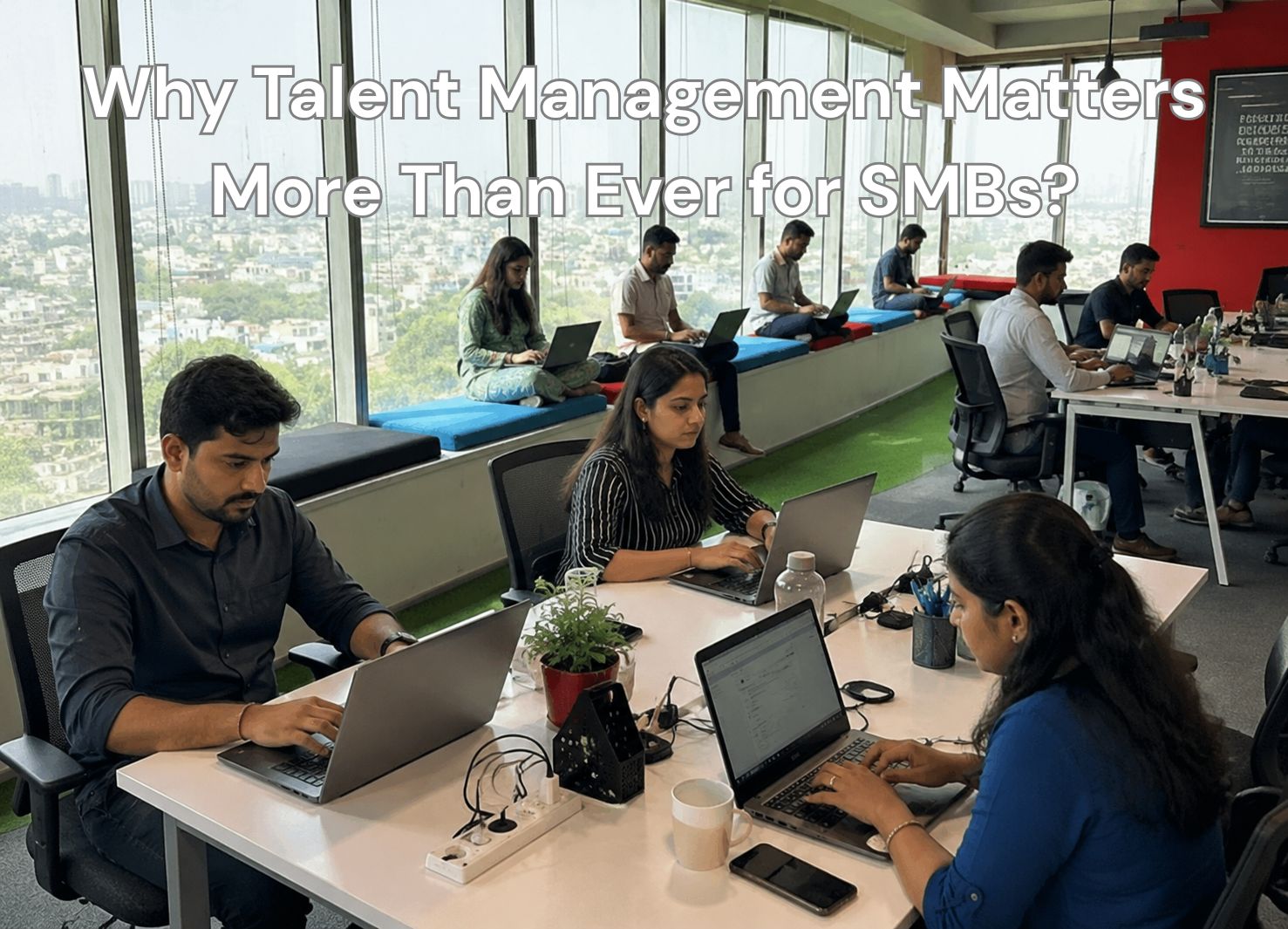
Talent management is the end-to-end process of attracting, developing, engaging, and retaining employees so they contribute to business goals. For small and mid-sized businesses (SMBs) — especially the startups and lean teams working out of Indian coworking spaces — it matters now more than ever because hiring costs have risen, remote and hybrid teams are harder to keep aligned, and every departure hits a small team disproportionately hard. A structured talent management strategy is no longer a “big company” luxury; it’s a survival tool for lean, fast-growing teams.
What Is Talent Management?
Talent management is the ongoing set of HR practices — recruitment, onboarding, performance management, learning and development, succession planning, and retention — designed to ensure a business has the right people in the right roles at the right time. Unlike traditional HR, which focuses on administration and compliance, talent management is strategic: it treats people as a competitive asset, not a cost center.
For SMBs, this distinction is critical. A 15-person startup in a Bengaluru or Gurugram coworking space can’t afford six months of onboarding lag or a key employee walking out mid-project. Talent management gives founders and small HR teams a repeatable system instead of ad-hoc firefighting.
💡 Are you looking for Coworking space in Gurgaon, Noida or Delhi?. We are just a call away.
Call now: 08999 828282
Key Takeaways
- Talent management directly impacts retention, productivity, and revenue — not just “HR satisfaction.”
- SMBs lose disproportionately more when a single employee leaves compared to large enterprises.
- A defined talent management process reduces hiring costs and shortens time-to-productivity.
- Affordable talent management software and AI tools have made enterprise-grade practices accessible to small teams.
- Coworking environments create unique talent challenges (distributed teams, shared culture-building, flexible workforces) that a talent management framework can solve.
Why This Matters More Than Ever: The Data-Backed Case
Three shifts have made talent management urgent for SMBs in India:
- The cost of turnover has climbed. Replacing an employee typically costs between 50% and 200% of their annual salary once recruiting, onboarding, and lost-productivity time are factored in. For a 10-person team, losing even one skilled employee can stall a product launch or client delivery for weeks.
- Hybrid and coworking-based teams face weaker organic culture-building. When employees work from shared coworking spaces, freelancer hubs, or hybrid schedules, the informal mentorship and cultural absorption that happens naturally in a traditional office doesn’t happen by accident anymore. It has to be designed.
- India’s talent market has become more competitive, not less. With startups, IT services, and D2C brands all competing for the same pool of skilled early-career and mid-level professionals in cities like Bengaluru, Pune, Hyderabad, and Delhi-NCR, SMBs can no longer out-hire larger competitors on salary alone — they have to out-manage them on growth, culture, and clarity.
The Talent Management Process: A Step-by-Step Framework
A practical talent management model for SMBs follows six connected stages. Skipping any one weakens the whole chain.
| Stage | What Happens | SMB-Specific Tip |
| 1. Workforce Planning | Forecast roles needed against business goals | Tie hiring plans to quarterly revenue milestones, not gut feel |
| 2. Sourcing & Recruitment | Attract and screen candidates | Use coworking community networks and referrals — cheaper than job portals |
| 3. Onboarding | Integrate new hires into role and culture | Build a 30-60-90 day plan even for a team of 5 |
| 4. Performance Management | Set goals, give feedback, track progress | Use lightweight, frequent check-ins over annual reviews |
| 5. Learning & Development | Build skills aligned to growth needs | Micro-learning and peer mentoring beat costly external training |
| 6. Retention & Succession | Keep top performers, plan for gaps | Identify a backup for every critical role, even informally |
This is a simplified but functional talent management framework — most enterprise models (like the widely referenced ones from CIPD or SHRM) contain the same six pillars, just with more layers of process. SMBs don’t need the layers; they need the discipline.
Talent Management Strategy: What Most Advice Gets Wrong
Most generic articles on this topic assume a mid-size or enterprise HR department. Here’s what they typically miss for SMBs and coworking-based teams:
- They assume a dedicated HR function exists. Many SMBs run talent management through the founder or a single ops person. The right approach is a strategy simple enough for a non-specialist to run consistently — not a policy binder nobody reads.
- They underweight community and coworking dynamics. Employees in coworking spaces often see how other companies operate, compare perks and culture informally, and can be poached over a coffee conversation. A strong internal culture and clear growth path matter more here than in an isolated office.
- They over-recommend expensive enterprise software. Full-suite platforms built for 500+ employee companies are overkill and expensive for a 20-person team. What SMBs need is scalable talent management tools that grow with headcount.
Talent Management Software and Tools: What SMBs Actually Need
A talent management system doesn’t need to be a six-figure enterprise suite. For most SMBs, the right talent management solutions cover four functions:
- Applicant tracking — organizing candidates without spreadsheets
- Performance and goal tracking — lightweight OKR or check-in tools
- Onboarding checklists — automated task assignment for new hires
- Basic analytics — attrition rate, time-to-hire, engagement pulse
Popular affordable options in the Indian SMB market include Keka, Darwinbox (as teams scale), Zoho People, and BambooHR — each offering modular pricing so a 10-person team isn’t paying enterprise rates.
Also Read: Why Talent Development Is a Smart Investment for Business Owners?
AI in Talent Management
AI in talent management is now practical even for small teams, not just large enterprises. Common, low-cost applications include:
- AI-assisted resume screening to shortlist candidates faster
- Predictive attrition flags based on engagement and performance patterns
- Automated interview scheduling and onboarding workflows
- AI-generated learning recommendations tailored to skill gaps
The realistic expectation: AI speeds up the mechanical parts of talent management process work (screening, scheduling, reporting) — it doesn’t replace judgment on culture fit, growth conversations, or retention strategy. Founders should treat AI as an efficiency layer, not a decision-maker.
Talent Management Practices for Coworking-Based Teams
Coworking space users face a specific version of this challenge: teams are often distributed, informal, and fast-changing. Effective talent management techniques for this context include:
- Structured weekly 1:1s, even 15 minutes, to replace hallway conversations that don’t happen in shared spaces
- Visible growth paths documented simply — employees in coworking environments compare notes with peers at other companies and notice when there’s no clear next step
- Community-based referral hiring — coworking networks are a genuinely underused sourcing channel
- Flexible, outcome-based performance management rather than presence-based tracking, since coworking teams often work varied schedules
💡 Are you looking for Coworking space in Gurgaon, Noida or Delhi?. We are just a call away.
Call now: 08999 828282
Building a Talent Management Plan: Practical Recommendations
For a founder or small team lead starting from scratch, a realistic talent management plan looks like this:
- Document your current roles and where gaps exist against 6-month goals
- Set a repeatable onboarding checklist (even a shared doc is fine to start)
- Introduce monthly 1:1 check-ins with clear, simple goal tracking
- Choose one affordable talent management software tool to centralize hiring and performance data
- Review attrition and hiring costs quarterly — treat it like any other business metric
Final Word
Talent management isn’t a large-enterprise concept anymore — it’s become one of the most practical growth levers available to SMBs, particularly those operating in India’s fast-moving coworking ecosystem. Businesses that treat people strategy as seriously as product or sales strategy are better positioned to retain top talent, grow faster, and manage costs effectively. The right workspace can also play an important role in creating a productive, collaborative environment for growing teams. For businesses looking for a flexible and professional coworking space, The Office Pass (TOP) offers workspaces designed to support teams as they scale. Contact TOP at +91-8999-828282 to explore workspace options for your business.
FREQUENTLY ASKED QUESTIONS (FAQS):
Question: What is the difference between HR management and talent management?
Answer: HR management handles administrative and compliance functions (payroll, leave, contracts). Talent management is strategic — focused on attracting, developing, and retaining people to drive business outcomes.
Question: Do small businesses really need a talent management system?
Answer: Yes. Even a 10-person team benefits from structured hiring, onboarding, and performance tracking — the cost of losing one employee to poor management is proportionally higher for small teams than for large enterprises.
Question: What talent management software is affordable for Indian startups?
Answer: Zoho People, Keka, and BambooHR offer modular, pay-as-you-grow pricing suitable for SMBs, unlike enterprise suites priced for large workforces.
Question: How does AI help small teams with talent management?
Answer: AI speeds up screening, scheduling, and attrition-risk flagging, freeing founders and small HR teams to focus on culture and growth conversations that AI can’t replace.
Question: How is talent management different for coworking-based teams?
Answer: Coworking teams need more deliberate culture-building and communication structures, since the informal bonding of a traditional office doesn’t happen automatically in shared or hybrid environments.