

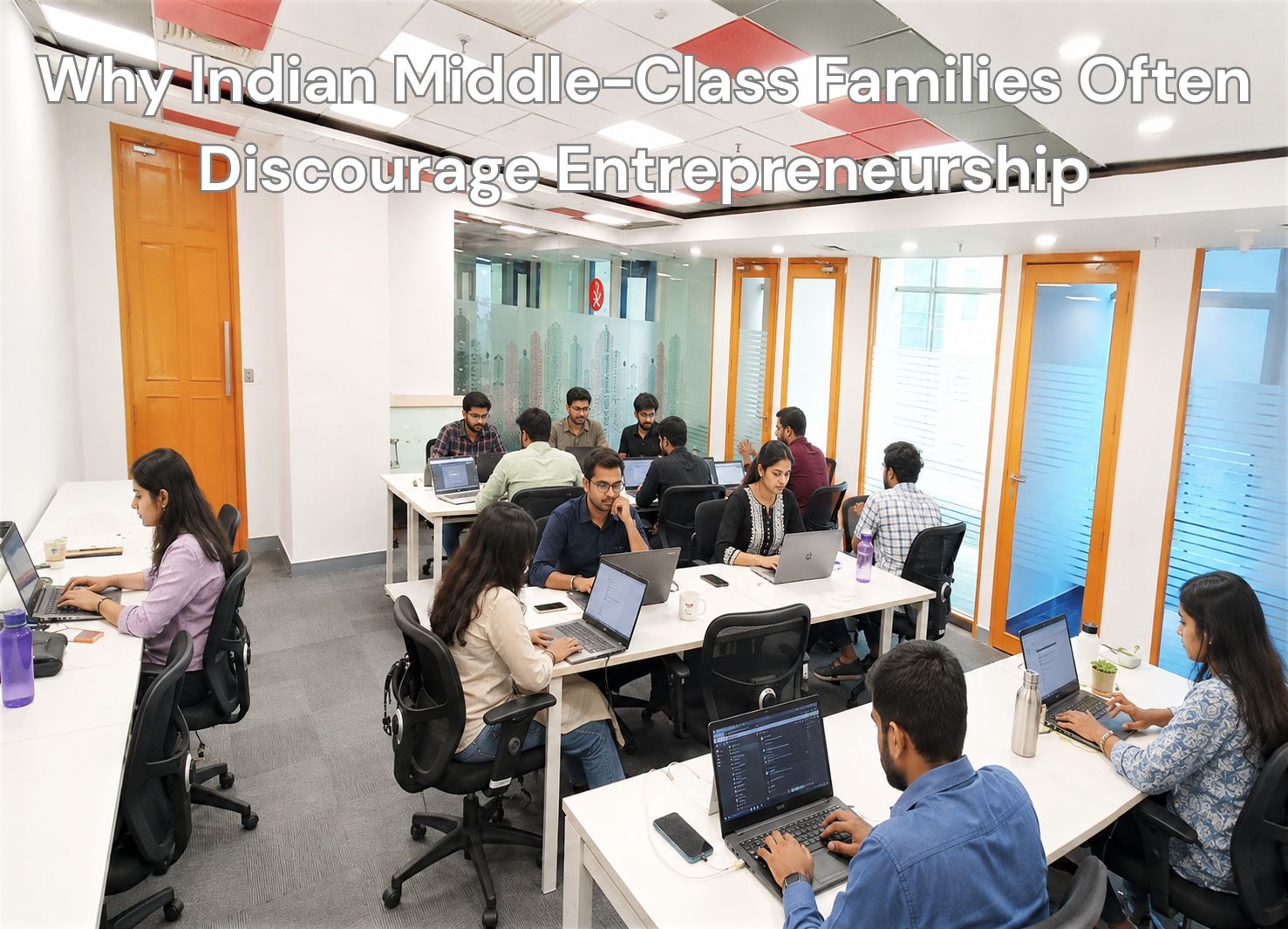
India’s startup ecosystem is booming. According to Startup India, the country now has more than 2.23 lakh recognized startups, creating millions of jobs and inspiring a new generation of founders. Yet, in many middle-class households, a secure job offer still brings more relief than a startup idea.
Why does this happen? Why do families that encourage hard work and ambition often hesitate when entrepreneurship enters the conversation? Much of it comes down to financial security, social expectations, and the fear of failure in entrepreneurship. In this blog, we’ll explore how these factors shape the entrepreneurship culture in India, and why attitudes toward entrepreneurship are slowly beginning to change.
💡 Are you looking for Coworking space in Gurgaon, Noida or Delhi?. We are just a call away.
Call now: 08999 828282
Why Entrepreneurship Is Still a Difficult Career Choice for Many Indian Middle-Class Families?
In many Indian middle-class households, a stable job is still seen as the safest route to a comfortable life. While startup success stories are everywhere today, parents often prefer careers that offer predictable income and long-term security. This mindset remains one of the key barriers to entrepreneurship in India.
- The Comfort of a Steady Paycheck: A monthly salary brings certainty, while a new business can take time to generate income.
- Fear of Taking a Big Risk: Many families worry about what could go wrong rather than what could go right.
- The Pressure to Choose a “Safe” Career: Jobs in established companies or government organizations are often viewed as more reliable.
- Responsibilities Come First: When family finances depend on one earning member, taking a business risk can feel difficult.
- Few Entrepreneurial Role Models: If no one in the family has run a business before, entrepreneurship can seem unfamiliar and uncertain.
Also Read: Business Ethics in Shared Workspaces: Best Practices for Modern Companies
Reasons Why Indian Middle-Class Families Do Not Encourage Entrepreneurship
Despite the rise of startups and unicorns, many Indian middle-class families still consider entrepreneurship a risky path. Their concerns are often shaped by financial realities, social expectations, and generations of believing that a stable job is the safest route to success.
The table below highlights the key reasons entrepreneurship remains a challenging career choice for many aspiring founders.
| Reason | Why Families Worry? |
| 1. Financial Uncertainty | Income is not guaranteed |
| 2. Fear of Failure | Business setbacks can be difficult to handle |
| 3. Preference for Stable Careers | Jobs offer predictability |
| 4. Family Responsibilities | Financial obligations come first |
| 5. Social Pressure | Society often values traditional careers |
| 6. Lack of Business Exposure | Entrepreneurship feels unfamiliar |
| 7. Fear of Debt | Loans and investments involve risk |
| 8. Limited Mentorship | Guidance is not always available |
| 9. Marriage and Lifestyle Expectations | Stability is often prioritized |
| 10. Delayed Financial Rewards | Success can take years |
Let us elaborate a bit on these common barriers to entrepreneurship in India:
1. Financial Uncertainty
Unlike a salaried job, entrepreneurship does not guarantee a monthly income. For families that have worked hard to achieve financial stability, this uncertainty can feel uncomfortable.
Example: A young professional earning a steady salary may be discouraged from leaving their job to launch a startup with uncertain earnings.

2. Fear of Failure
The fear of failure in entrepreneurship remains one of the biggest reasons families hesitate to support business ventures. Many worry about both financial losses and social judgment.
Example: If a startup fails, people often ask what went wrong instead of recognizing the effort and learning involved.
3. Preference for Stable Careers
Traditional professions such as engineering, medicine, banking, and government services continue to be viewed as reliable career choices.
Example: Parents may feel more secure when their child joins a multinational company than when their child decides to start a business.
4. Family Responsibilities
Many middle-class professionals support parents, contribute to household expenses, or save for future goals. Taking a business risk can feel difficult when others depend on their income.
Example: Someone helping pay for a sibling’s education may postpone entrepreneurial plans to maintain financial stability.
Also Read: Top Performance Management Strategies Every Manager Should Know
5. Social Pressure and Expectations
Family members, relatives, and even neighbors often influence career decisions. Entrepreneurship may be questioned because it does not follow the traditional definition of success.
Example: At family gatherings, a government job may receive more praise than a newly launched startup.
6. Lack of Business Exposure
Many families have generations of salaried professionals and little experience with business ownership. As a result, entrepreneurship can seem unfamiliar.
Example: Parents who have never run a business may find it difficult to understand startup challenges and opportunities.
7. Fear of Debt and Financial Losses
Starting a business often requires investment, which can create concerns about loans, savings, and financial security.
Example: Families may worry about a founder using personal savings or taking a loan to fund a new venture.
8. Limited Access to Mentorship
Many aspiring entrepreneurs lack guidance from experienced founders or industry experts. Without support, entrepreneurship can appear more difficult than it actually is.
Example: A first-time entrepreneur may struggle with fundraising or customer acquisition because they lack a mentor to guide them.
9. Marriage and Lifestyle Expectations
In many households, financial stability remains an important factor in major life decisions such as marriage, home ownership, and family planning.
Example: Families may see a steady corporate job as a stronger foundation for long-term commitments than an early-stage startup.
10. Delayed Financial Rewards
Most successful businesses take time to grow. While jobs provide immediate income, startups may require years of effort before becoming profitable.
Example: A startup founder may spend the first few years reinvesting earnings rather than drawing a regular salary.
💡 Are you looking for Coworking space in Gurgaon, Noida or Delhi?. We are just a call away.
Call now: 08999 828282
How the Indian Middle-Class Mindset Toward Entrepreneurship Is Changing?
The perception of entrepreneurship is gradually shifting across Indian middle-class households. While job security remains important, more families are recognizing that startups, freelancing, and self-employment can also lead to long-term success.
- Startup Success Stories: Well-known founders and growing startups have shown that entrepreneurship can be a rewarding career path.
- Technology-Driven Opportunities: Digital tools and online platforms have made it easier and more affordable to start a business.
- Improved Access to Funding: Investors, startup incubators, and government initiatives have increased funding opportunities for entrepreneurs.
- Growing Acceptance of Freelancing: More professionals are building successful careers outside traditional employment.
- Stronger Startup Communities: Coworking spaces, networking events, and mentorship programs are helping entrepreneurs gain confidence and support.
Why Entrepreneurship Can Be a Strong Career Option Today?
Entrepreneurship is no longer limited to people with large investments or family businesses. With access to technology, funding, and digital markets, entrepreneurship has become a realistic career path for many aspiring professionals despite the fear of failure.
- Opportunity to Innovate: Entrepreneurs can solve real-world problems through new products and services.
- Wealth Creation Potential: Successful businesses can create long-term financial growth.
- Greater Flexibility: Founders have more control over their work and business decisions.
- Job Creation: Businesses contribute to the economy by creating employment opportunities.
- Personal Growth: Entrepreneurship helps develop leadership, problem-solving, and decision-making skills.
Also Read: How a Great Workspace Can Elevate Your Customer Experience?
Common Myths Indian Families Have About Entrepreneurship?
Many concerns around entrepreneurship come from assumptions that may no longer reflect today’s business landscape. As the culture of entrepreneurship in India evolves, it is important to separate common myths from reality.
The table below highlights some of the most common misconceptions about entrepreneurship and the realities that aspiring entrepreneurs and their families should understand.
| Myth | Reality |
| Entrepreneurship is only for wealthy people. | Many successful businesses start with small investments and smart planning. |
| Starting a business is riskier than a job. | Every career has risks; businesses simply involve different types of risk. |
| Failure means the end of your career. | Many successful entrepreneurs have learned from failed ventures. |
| You need a family business background. | Skills, knowledge, and mentorship matter more than family history. |
| Entrepreneurs earn quickly. | Most businesses take time to grow and become profitable. |
| A stable job is always safer. | Economic changes, layoffs, and industry disruptions can affect jobs, too. |
What Can Families Do to Support Aspiring Entrepreneurs?
Family support can make a significant difference in an entrepreneur’s journey. While concerns about risk are natural, encouragement and practical guidance can help young founders make better decisions and build confidence.
- Listen to Their Ideas: Understand the business concept before dismissing it.
- Encourage Smart Planning: Focus on research, budgeting, and realistic goals.
- Support Skill Building: Promote learning in finance, marketing, and business management.
- Help Build Networks: Introduce them to mentors, professionals, and industry contacts.
- Accept That Setbacks Happen: Every entrepreneurial journey includes lessons and challenges.
Are you looking for Coworking space in Gurgaon, Noida or Delhi?. We are just a call away. Call now: 08999 828282
The Economic Impact of Encouraging Entrepreneurship in India
When more people start businesses, the benefits extend far beyond individual success. Entrepreneurs create jobs, introduce new ideas, and contribute to the growth of local communities and the national economy. A stronger culture of entrepreneurship in India can help drive innovation and create opportunities for future generations.
- Creates New Jobs: Growing businesses need people, creating employment opportunities.
- Brings New Ideas to Market: Startups often solve everyday problems in creative ways.
- Supports Local Growth: Successful businesses help local economies thrive.
- Attracts Investment: Strong startups draw interest from investors and business partners.
- Builds Economic Resilience: A diverse business ecosystem strengthens the economy over time.
Also Read: Why Talent Management Matters More Than Ever for SMBs?
Entrepreneurship vs Traditional Jobs: Which Is Better for the Next Generation?
Entrepreneurship and traditional jobs both have their advantages. Some people value the stability of a regular paycheck, while others are drawn to the freedom and opportunities that come with building something of their own. The best choice depends on what an individual wants from their career.
The table below highlights the key differences between the two paths.
| Factor | Entrepreneurship | Traditional Job |
| Income | May be unpredictable at first | Regular monthly salary |
| Risk | Higher level of uncertainty | Generally more secure |
| Flexibility | Greater control over time and work | Structured schedule and responsibilities |
| Growth | Potential to scale a business | Career growth within an organization |
| Decision-Making | Make your own business decisions | Work within company policies |
| Learning | Exposure to multiple business areas | Focus on a specific role or function |
| Stability | Builds over time | Usually available from the start |
| Impact | Can create jobs and businesses | Contribute through professional expertise |
💡 Are you looking for Coworking space in Gurgaon, Noida or Delhi?. We are just a call away.
Call now: 08999 828282
Conclusion
For many Indian middle-class families, concerns about entrepreneurship often stem from a desire to protect financial stability rather than from discouraging ambition. But the landscape is changing. With easier access to technology, funding, mentorship, and startup communities, building a business is more achievable today than it was a few years ago. Many of the traditional barriers to entrepreneurship in India are gradually becoming easier to navigate.
Although the fear of failure in entrepreneurship hasn’t disappeared completely, more people now see setbacks as part of the learning process rather than the end of the road. As the entrepreneurship culture in India continues to grow, aspiring founders have more resources and support than ever before.
Having the right environment can make a real difference. The Office Pass (TOP) offers premium coworking spaces across Noida, Delhi, and Gurgaon, giving entrepreneurs, freelancers, startups, and small businesses a professional place to work, connect, and grow. From networking opportunities to flexible office solutions, TOP helps create an ecosystem where ideas can turn into successful ventures.
Ready to take the next step? Contact The Office Pass (TOP) at +91-8999-828282 and find a workspace that grows with your business.
FREQUENTLY ASKED QUESTIONS (FAQS):
Question: Why do many Indian middle-class families prefer traditional career paths over entrepreneurship?
Answer: Middle-class families often prioritize stability and financial security, which traditional career paths like medicine, engineering, or government jobs are perceived to provide.
Question: Do middle-class families in India discourage entrepreneurship due to a fear of financial risk?
Answer: Yes, the fear of financial instability associated with entrepreneurship can significantly discourage middle-class families from supporting it.
Question: Is societal pressure a common reason for discouraging entrepreneurship among Indian middle-class families?
Answer: Yes, societal expectations and the desire for social status can lead families to discourage entrepreneurship in favor of more conventional careers.
Question: How can a lack of understanding about entrepreneurship affect support from middle-class families?
Answer: A lack of understanding about entrepreneurship can lead to skepticism and a lack of support from families who may not see it as a viable career option.
Question: Are there any financial constraints that deter middle-class families from supporting entrepreneurship?
Answer: Yes, starting a business often requires significant capital, which middle-class families may be hesitant to risk.
Question: What efforts are being made to change perceptions and encourage entrepreneurship in India?
Answer: Various government initiatives, educational programs, and success stories of Indian entrepreneurs are working to change perceptions and promote entrepreneurship.
Question: Are there any specific industries or sectors where middle-class families are more supportive of entrepreneurship?
Answer: In recent years, there has been growing support for entrepreneurship in sectors like technology, e-commerce, and startups, where success stories have gained prominence.