

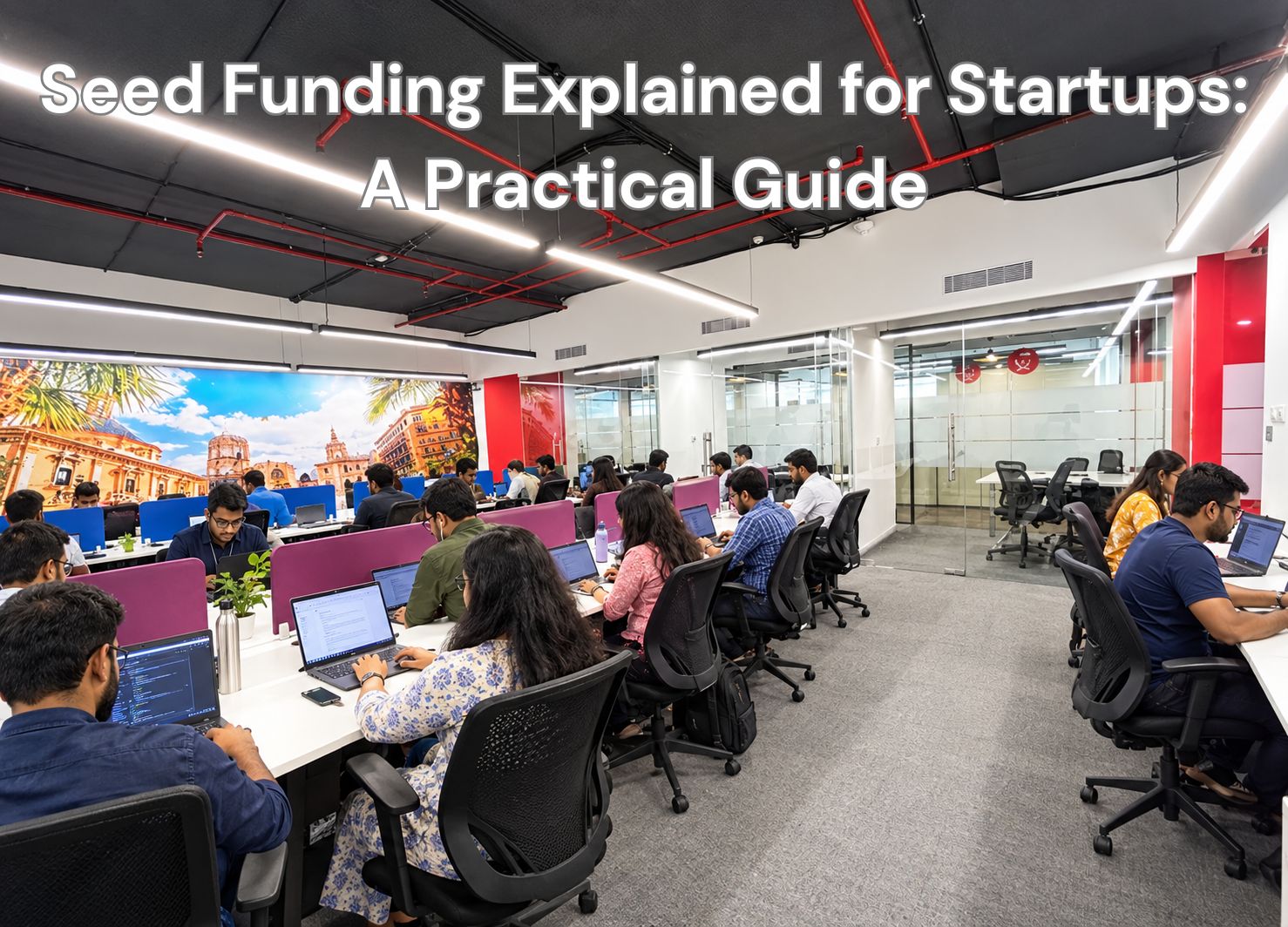
Seed funding is the first official round of capital a startup raises to turn an idea into a working business — used to build a minimum viable product (MVP), hire a founding team, and validate the market before chasing larger institutional rounds. In India, seed rounds typically range from ₹50 lakh to ₹4 crore ($60,000–$500,000), though AI and deep-tech startups are increasingly raising more.
If you’re working out of a coworking space in Bengaluru, Gurugram, or Pune, chances are you’re surrounded by founders at exactly this stage. This guide breaks down what seed funding actually is, where to find it, how it works in the Indian ecosystem, and what mistakes to avoid.
What Is Seed Funding?
Seed funding is the capital injected into a startup at its earliest stage — often before the company has significant revenue — to help it move from concept to a testable product. The term “seed” is deliberate: it’s the money that lets an idea germinate before it needs to scale.
Unlike a bank loan, seed funding is usually equity-based, meaning investors receive a stake in the company rather than requiring repayment with interest. This is what separates seed capital for startups from traditional business financing.
Seed Funding vs. Other Funding Rounds
| Stage | Typical Amount (India) | Purpose | Common Investors |
| Pre-seed | ₹10–50 lakh | Idea validation, prototype | Founders, friends & family, incubators |
| Seed | ₹50 lakh–₹4 crore | MVP, early traction, team building | Angels, seed VC funds, accelerators |
| Series A | ₹4–40 crore | Scaling proven business model | Venture capital firms |
| Series B+ | ₹40 crore+ | Market expansion, growth | VC firms, PE investors |
💡 Are you looking for Coworking space in Gurgaon, Noida or Delhi? We are just a call away.
Call Now: 08999 828282
Why Seed Funding Matters for Early-Stage Founders?
Most first-time founders — especially solo founders or two-person teams working out of a coworking desk — underestimate how capital-intensive even a lean MVP can be. Seed money funding typically covers:
- Product development and initial engineering hires
- Cloud infrastructure and tooling costs
- Legal, compliance, and incorporation expenses
- Early marketing and customer acquisition tests
- Coworking or office space and operational overhead
A well-structured seed round doesn’t just provide cash — it validates your idea in front of experienced investors, and often brings mentorship, warm introductions, and credibility that helps with the next round.
Where to Get Seed Funding in India?
- Angel Investors
- Seed Venture Funds
- Accelerators and Incubators
- Government Schemes
- Crowdfunding and Micro-VC Platforms
1. Angel Investors
Individual, high-net-worth investors who write early checks, often ₹10 lakh–₹1 crore. Networks like Indian Angel Network, Mumbai Angels, and Lets Venture are active in this space. Angels often move faster than institutional funds and are more open to unproven ideas.

2. Seed Venture Funds
Dedicated seed venture funds such as Blume Ventures, 100X.VC, India Quotient, and Titan Capital focus exclusively on early-stage bets. They typically invest ₹50 lakh–₹4 crore in exchange for equity and often lead the round with a lead investor structure.
3. Accelerators and Incubators
Programs like Y Combinator, Techstars, T-Hub, and NASSCOM 10000 Startups offer a fixed check (often $20,000–$125,000) plus mentorship in exchange for equity, usually 6–10%. Many coworking spaces have informal or formal ties to local incubators — worth checking with your community manager.
4. Government Schemes
The Startup India Seed Fund Scheme (SISFS) provides up to ₹50 lakh to DPIIT-recognized startups through approved incubators, covering both proof-of-concept and market-entry stages. This is an underused route many founders overlook because it requires DPIIT registration first.
Also Read: How SMEs Can Use Crowdfunding to Raise Capital?
5. Crowdfunding and Micro-VC Platforms
Equity crowdfunding and platforms like Tyke and Grip allow founders to raise smaller amounts from a wider pool, particularly useful for consumer-facing startups with community traction.
How Seed Funding Works: The Process
- Prepare your pitch deck and financial model — investors expect 10–15 slides covering problem, solution, market size, traction, team, and ask.
- Build a target investor list — segment by sector focus, check size, and stage.
- Get warm introductions — cold outreach converts poorly; coworking communities, founder WhatsApp groups, and accelerator alumni networks are valuable here.
- Negotiate terms — decide between a SAFE/convertible note or priced equity round.
- Due diligence — investors verify financials, cap table, IP ownership, and compliance.
- Term sheet and closing — legal documentation, ROC filings, and fund transfer.
SAFE Notes vs. Equity: Which Should You Choose?
Most Indian seed rounds today use SAFE (Simple Agreement for Future Equity) notes or convertible notes rather than a priced equity round. This defers the valuation conversation to a later round, saving time and legal cost. A priced round, by contrast, fixes valuation immediately and is more common when the round size is large or a lead investor insists on clarity.
Practical recommendation: if you’re raising under ₹2 crore and want to close fast, a SAFE note is usually the pragmatic choice for early-stage Indian startups.
How Much Equity Should You Give Up?
A healthy seed round typically dilutes founders by 10–20%. Giving away more than 25% at seed stage is a red flag — it leaves little room for Series A dilution and can demotivate the founding team. Cap table discipline started early prevents painful renegotiations later.
Common Mistakes Founders Make
- Raising too early, before there’s any signal of demand — investors want to see at least a working prototype or early users.
- Over-optimizing valuation instead of finding investors who add strategic value.
- Ignoring the cap table until it becomes messy and hard to fix before Series A.
- Skipping legal review of SAFE/convertible note terms, especially valuation caps and discount rates.
- Treating seed funding as validation rather than as a resource with strings attached — investors expect updates, governance rights, and eventually returns.
💡 Are you looking for Coworking space in Gurgaon, Noida or Delhi? We are just a call away.
Call Now: 08999 828282
Key Takeaways
- Seed funding is early-stage capital raised before Series A, usually to build and validate a product.
- Indian seed rounds commonly range from ₹50 lakh to ₹4 crore, depending on sector and traction.
- Common sources: angel investors, seed VC funds, accelerators, crowdfunding, and government schemes like Startup India Seed Fund Scheme (SISFS).
- Most seed deals use SAFE notes or CCPS (Compulsory Convertible Preference Shares) rather than straight equity.
- Founders typically give up 10–20% equity in a seed round.
- A strong pitch deck, clear unit economics, and a coworking/community presence can meaningfully improve fundraising odds.
Final Thoughts
Seed funding gives startups the financial support needed to turn an idea into a viable business, build an early product, and gain market traction. However, funding alone is not enough. Startups also need the right environment to collaborate, meet clients, and grow efficiently. The Office Pass (TOP) coworking spaces provide flexible workspaces designed for ambitious teams and growing businesses. Contact TOP at +91-8999-828282 to explore a workspace that supports your startup journey.
FREQUENTLY ASKED QUESTIONS (FAQS):
Question: What is the difference between seed funding and pre-seed funding?
Answer: Pre-seed funding is smaller and earlier, often used to build a prototype or validate an idea before any real traction. Seed funding follows once there’s a working product or early user base, and is used to scale initial traction.
Question: How much seed funding can an Indian startup raise?
Answer: Indian seed rounds typically range from ₹50 lakh to ₹4 crore ($60,000–$500,000), though this varies significantly by sector — deep-tech and AI startups often raise more.
Question: Do I need a company registered to raise seed funding?
Answer: Yes. Most investors require a registered private limited company, and DPIIT recognition is needed to access government schemes like SISFS.
Question: How long does it take to close a seed round in India?
Answer: On average, 2–4 months from first investor conversation to funds in the bank, though strong traction or warm networks can shorten this.
Question: Is seed funding the same as venture capital?
Answer: Not exactly. Seed funding is a stage of financing, while venture capital is a source of capital. Seed funding can come from VCs, but also from angels, accelerators, and government schemes.