

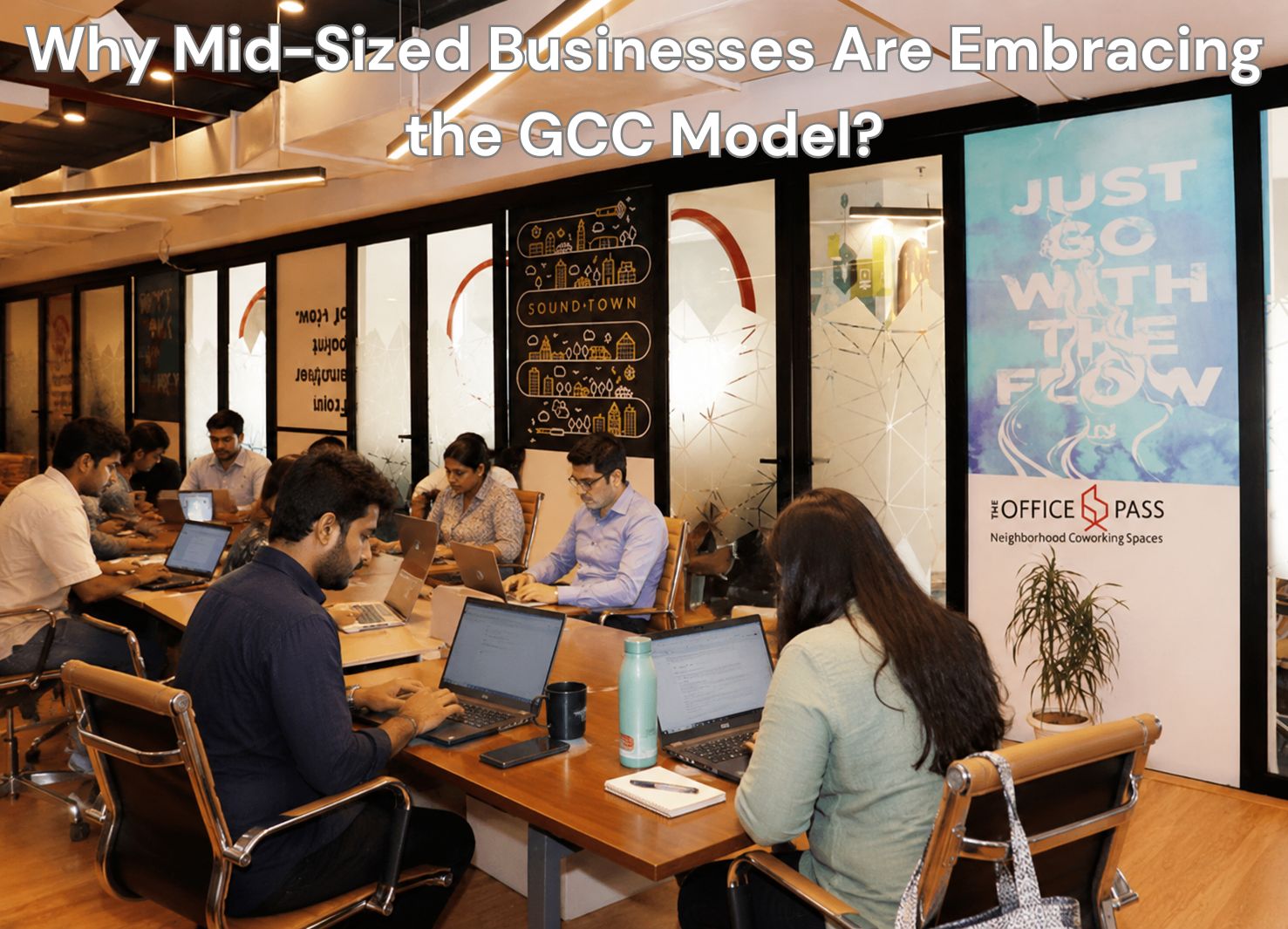
Mid-sized businesses are adopting the GCC model because it lets them set up a dedicated, wholly-owned offshore or onshore unit — a Global Capability Center — that delivers cost savings, access to skilled talent (especially in India), and greater control than traditional outsourcing, without the overhead of building an entire subsidiary from scratch.
What Is the GCC Model?
A Global Capability Center (GCC) is a dedicated unit that a company sets up, usually in a lower-cost, talent-rich country like India, to handle specific business functions — IT, finance, analytics, R&D, HR, or customer operations — under its own ownership and management.
Unlike outsourcing, where a third party controls the work, the GCC business model keeps operations, IP, and quality standards entirely in-house. This is often called the GCC operating model, and it’s why global enterprises like Google, Goldman Sachs, and Walmart have run large centers out of India for years.
What’s changed recently is scale: it’s no longer just Fortune 500 companies. Mid-sized businesses — with 200 to 2,000 employees globally — are now setting up global capability centers of their own, often starting small in flexible, managed spaces rather than large campuses.
💡 Are you looking for Coworking space in Gurgaon, Noida or Delhi?. We are just a call away.
Call now: 08999 828282
Key Takeaways
- The GCC model gives mid-sized firms ownership and control that traditional outsourcing doesn’t offer.
- India remains the top destination due to talent depth, English proficiency, and cost efficiency.
- Coworking and managed office spaces have made GCC setup viable for smaller firms by removing the real-estate and infrastructure burden.
- Typical GCC functions for mid-sized firms: engineering, data analytics, finance & accounting, customer support, and product development.
- Setup timelines have compressed from 12–18 months to as little as 6–10 weeks using flexible workspace and GCC-as-a-service providers.
Why Mid-Sized Businesses Are Making the Shift?
- Cost Efficiency Without Losing Control
- Access to Deep, Specialized Talent
- Flexible Real Estate Has Removed the Biggest Barrier
- Speed to Market
- Innovation Proximity, Not Just Cost Arbitrage
1. Cost Efficiency Without Losing Control
Traditional outsourcing cuts cost but also cuts visibility. A GCC lets a company retain full control over hiring, processes, and IP while still benefiting from lower operating costs in India — often 40–60% lower than equivalent operations in the US, UK, or Australia.
2. Access to Deep, Specialized Talent
India produces over 1.5 million engineering graduates annually, alongside a mature pool of finance, analytics, and product talent. For mid-sized firms that can’t compete with Big Tech salaries in their home market, a GCC opens access to comparable skill at a fraction of the cost.
3. Flexible Real Estate Has Removed the Biggest Barrier
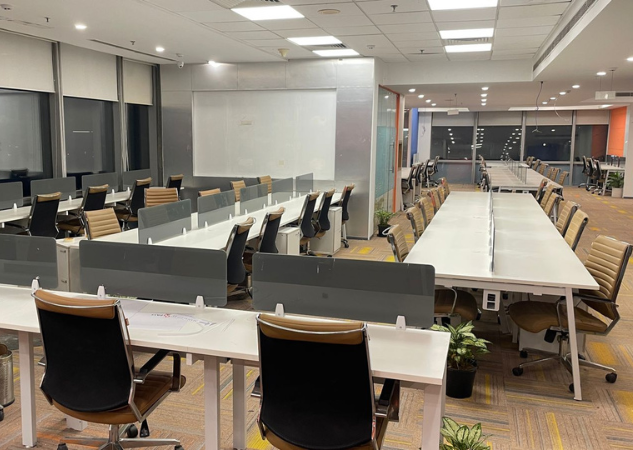
Historically, GCCs meant a 50,000 sq. ft. campus lease and a multi-year commitment — unrealistic for a 150-person company. That’s changed. Global capability center services offered through managed and coworking operators now let companies:
- Start with 10–50 seats in a plug-and-play managed office
- Scale up floor-by-floor as headcount grows
- Avoid capex on interiors, IT infrastructure, and compliance setup
- Exit or downsize without long lease liabilities
This is the single biggest reason mid-sized businesses can now realistically run a GCC operating model that was previously the domain of large enterprises only.
4. Speed to Market
A DIY GCC setup — entity registration, real estate, hiring, compliance — traditionally took 9–18 months. With GCC-as-a-service providers and coworking partners handling entity support, workspace, and HR infrastructure, mid-sized firms are now operational in 6–10 weeks.
5. Innovation Proximity, Not Just Cost Arbitrage
A pattern often missed in competitor content: mid-sized GCCs today are rarely set up purely for cost savings. Many are placed near India’s product and AI talent hubs specifically to co-locate engineering with global product teams, treating the GCC as a genuine second headquarters for innovation rather than a back-office.
Also Read: Market Positioning Strategy 101: How to Own Your Niche?
GCC Model vs. Outsourcing vs. Staff Augmentation
| Factor | GCC Model | Outsourcing | Staff Augmentation |
| Ownership | Company-owned | Third-party owned | Company-managed, vendor-employed |
| IP Control | Full | Limited | Partial |
| Cost | Low-medium (setup cost, low opex) | Low | Medium |
| Talent Selection | Direct hiring control | Vendor-decided | Shared control |
| Scalability | High, especially with coworking | Vendor-dependent | Moderate |
| Best For | Long-term core functions | Non-core, transactional work | Short-term skill gaps |
How Mid-Sized Businesses Are Setting Up GCCs: A Practical Path
- Define the function scope — start with 1–2 functions (e.g., engineering + analytics), not everything at once.
- Choose a flexible workspace partner — managed offices or enterprise coworking suites reduce setup time and capex.
- Set up the legal entity — usually a private limited company or branch office, done in parallel with workspace selection.
- Hire a founding team of 15–30 — anchor with 2–3 senior leaders who’ve worked in GCCs before.
- Scale in phases — expand seats and functions every 2–3 quarters based on performance, not a fixed real estate plan.
Common Mistakes Mid-Sized Firms Should Avoid
- Over-committing to real estate too early — locking into a large lease before headcount is proven.
- Treating the GCC as an outsourcing vendor — it should be run with the same standards as HQ, not managed at arm’s length.
- Ignoring compliance nuances — Indian labor law, tax structuring, and data protection (DPDP Act) require local expertise from day one.
- Underestimating leadership needs — a GCC without an empowered local leader tends to stagnate as a low-value cost center.
💡 Are you looking for Coworking space in Gurgaon, Noida or Delhi?. We are just a call away.
Call now: 08999 828282
The Bottom Line
The GCC model has evolved from an enterprise-only strategy into a practical option for mid-sized businesses, with flexible workspaces making global capability centers more accessible, scalable, and cost-effective. For companies looking to balance cost, control, and access to India’s talent pool, a coworking-led GCC can offer a faster, lower-risk alternative to building a full campus. TOP Coworking provides flexible, professional workspaces that can support growing GCC teams without the complexity of traditional office setups. Contact The Office Pass (TOP) at +91-8999-828282 to explore workspace solutions tailored to your business.
FREQUENTLY ASKED QUESTIONS (FAQs):
Question: What is the difference between a GCC and a subsidiary?
Answer: A GCC is typically a functional unit (engineering, finance, support) set up under a subsidiary or branch entity. The subsidiary is the legal structure; the GCC is the operational model running inside it.
Question: Is the GCC model only for large enterprises?
Answer: No. With managed workspace and GCC-as-a-service providers, mid-sized businesses with as few as 50–100 planned roles can now set up a lean GCC in India.
Question: How much does it cost to set up a GCC in India?
Answer: Costs vary widely, but using flexible workspace instead of owned real estate, a mid-sized GCC can become operational for a fraction of traditional campus-based setup costs, with most spend going toward salaries rather than infrastructure.
Question: Which cities in India are best for a mid-sized GCC?
Answer: Bengaluru, Hyderabad, and Pune lead for tech and product talent; NCR and Chennai are strong for finance, analytics, and support functions.
Question: How long does it take to launch a GCC?
Answer: With a coworking or managed-office model, most mid-sized companies go from decision to operational team in 6–10 weeks, versus 9–18 months for a traditional build.