

5 Reasons Why Coworking Future Looks Bright With Hybrid Work?

Coworking Future Looks Bright With Hybrid Work

posted in: Coworking | 0

When people look for a job, flexibility is one of the highest-ranking criteria. After proving that their physical presence in an employer-controlled office isn’t linked to their productivity, employees are not keen on reverting to traditional work styles. 43% of respondents to a survey actually said that flexible working hours helped them be more productive.

While most employers aren’t keen on maintaining a WFH policy, they are open to the idea of a hybrid workspace. The key here is to give employees a structured yet convenient place to work from. Coworking spaces provide the balance between employees and employers expectations and hence, the coworking space future too looks bright. Here’s why:

5 Reasons Why Coworking Future Looks Bright With Hybrid Work?

  1. Leveraging A Coworking Office Space Optimizes Costs
  2. Coworking Offices Maintain A Professional Environment
  3. Coworking Spaces Have All The Required Infrastructure
  4. Desks Can Be Leased For As Little As A Day
  5. Coworking Spaces Allow Workers To Set Their Schedules

1. Leveraging A Coworking Office Space Optimizes Costs

For corporates, the switch to a hybrid working style helps lower costs. The corporate office is not likely to be at full strength at any given point in time. Hence, the space required is lower. Smaller offices mean lower rents. If the employees were to work from home, the company may need to reimburse them for the cost of setting up a home office, higher speed internet, etc. the cost may not be much for one individual but can add up to quite a bit depending on team size.

On the other hand, coworking space leases have an all-inclusive cost. This is much lower than the cost of renting a traditional corporate office. Further, choosing a coworking space close to an employee’s residence reduces the cost and time associated with commuting.

2. Coworking Offices Maintain A Professional Environment

When employees work from home, they’re faced with constant distractions. A survey found that 38% of remote workers struggled with finding a suitable workspace. Working from the bedroom puts employees at risk of back issues and makes it hard to stay focussed on working while working from the dining table opens one up to constant distractions. Childcare responsibilities were cited as a challenge by 22% of the survey respondents.

Source: Ipsos

On the other hand, a coworking space is designed specifically for working professionals. Each member gets his or her own desk space. There are no distractions of children asking for snacks, maids wanting instructions, etc. There’s no chance of having a 5-minute break turn into a binge-watching session either. When an employee feels distracted, one looks around to see everyone else focussed on their work can help bring him or her back on track.

3. Coworking Spaces Have All The Required Infrastructure

One of the issues with hybrid corporate shifts is making sure that employees have the infrastructure required to stay productive when they’re working from outside the office. This ranges from the basics like an ergonomic desk and chair to hi-speed internet and video conferencing equipment. For most employees, a laptop and a printer are the limits of the infrastructure they have available at home.

A survey saw slow internet speed and connectivity are listed as major challenges by 52% of the respondents. Unreliable connectivity affects the WFH employee’s ability to participate in online meetings and collaborate with their teams.

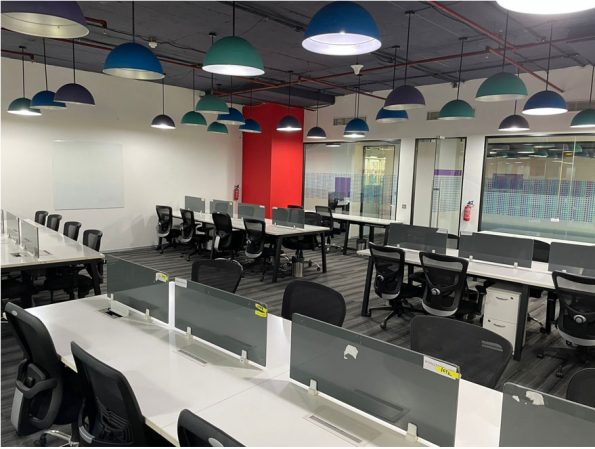
Since coworking spaces are designed for remote workers, they are fully furnished and equipped with all the productivity-related infrastructure that may be required. From hi-speed Wi-Fi connections to audio-visual equipment for hosting presentations, a coworking member gets access to it all.

The choice of flexible seating options further enhances productivity. When they need to work in a team, they can sit together at a community desk or book a meeting room. And, when they don’t want to be disturbed, they can pick a seat away from everyone else.

4. Desks Can Be Leased For As Little As A Day

The Hybrid work style is all about flexibility and coworking spaces celebrate this notion. There’s flexibility built into every aspect of their operations. It starts with shorter leases. Rather than force companies to rent out space for years at a time, coworking spaces give them the flexibility to lease as many desks for as much time as required.

Let’s say there’s a task that requires a team of 5 employees to work together for a week. While they may otherwise work from different locations, they can lease shared desk space for the duration of the project.

This is helpful especially for growing companies that may need 5 desks today and 10 desks tomorrow. It is also helpful for companies with employees who need to travel frequently.

5. Coworking Spaces Allow Workers To Set Their Schedules

The main reason for adopting a hybrid work style is to improve productivity. A study found that coworking spaces help improve productivity for corporates.

Coworking Spaces Allow Workers To Set Their Schedules

Source: Otter

Corporate offices typically start at a set time and remain open to a particular time. The trouble is, that people feel energized and productive at different times of the day that may extend beyond office timings. Someone may like to start their day early but because of the office timings they have to waste their most productive hours.

Coworking spaces are designed for freelancers, entrepreneurs and remote workers. Recognizing that everyone has different work styles and timings, these offices are open for much longer. You might even find some coworking spaces that are open 24X7. This doesn’t mean that you must expect your employees to be at work all day and all night!

In Conclusion

Coworking and a hybrid working style seem to go hand in hand. Of course, to maximise the benefits of the system, you need to choose the right coworking space. 

You need a coworking space that fits your budget but more importantly is easily accessible, well laid out and equipped with the necessary infrastructure. It should have a community that you want to be part of. 

The Office Pass (TOP) has several such coworking spaces in Delhi, Noida and Gurgaon. Whether you need a desk for 20 people or 100 or more, we have the perfect solution for you. To know more, reach out to the team at 08999 828282.

BOOK A COWORKING TOUR

6 Awesome Benefits of Community for Entrepreneurs You Should Know

6 Amazing Benefits Of A Community For Entrepreneurs

posted in: Entrepreneur | 0

Entrepreneurship is as exciting as it is challenging. It takes grit to stay focussed on building a brand when faced with hurdle after hurdle. It doesn’t help to know that 20% of new ventures don’t make it past the 1-year mark. What does help is having the right people with you. 

As an entrepreneur, you must surround yourself with people you can learn from, people who think differently and people who push you to do more. The best place to find such a community for entrepreneurs is in a coworking space.

Working out of a shared office space isn’t just about being cost-effective, it also helps you build a community you can rely on. Let’s take a look at the top 7 benefits of community for entrepreneurs.

6 Amazing Benefits Of A Community For Entrepreneurs

6 Top Benefits of Community for Entrepreneurs

  1. Ideating
  2. Networking
  3. Learning new skills
  4. Learning From Other Entrepreneur’s Mistakes
  5. Business Opportunities
  6. Emotional Support

1. Ideating

There’s a limit to the ideas one mind can come up with. But, when you discuss an issue or a challenge with someone else, you can brainstorm many more solutions. You get to see a challenge from different points of view and visualize solutions you missed out on earlier. You can refine your thought process too. 

One of the good things about being in a coworking space is that apart from brainstorming on your own, these spaces also often hold after-work events where you can talk about your ideas with fellow coworking members and get their insights. 

2. Networking

Business executives told a survey that they would lose 28% of their business if they did not network. Having a strong network is critical to an entrepreneur’s success. The people in your network will help you overcome challenges, prop you up when you’re feeling disheartened, help you promote your business and more. 

Networking doesn’t come easy to everyone. Some people are more reserved than others. The good part of being in a coworking space is that there are all kinds of people here and the space layout encourages interaction. If you’re the shy kind, you may find a more confident fellow entrepreneur to make introductions and help you expand your network. 

3. Learning New Skills

As an entrepreneur, no matter how much of an expert you think you are, you must be open to learning from the people around you. You can gain theoretical knowledge from your community or pick up new skills. 

For example, the graphic designer sitting next to you could teach you a few shortcuts that make your image editing quicker. 

As part of a community, you can also learn tips and tricks for running a new venture with limited resources. Someone may tell you about a website where you can get free icons for your presentations while another person could introduce you to a scheduler that helps with time management.

4. Learning From Other Entrepreneur’s Mistakes

Warren Buffet is right, “It’s good to learn from your mistakes. It’s better to learn from other people’s mistakes.” When you’re part of a community in a coworking office you get to see how other entrepreneurs operate. You get to understand what happens behind the scenes and see what works and what doesn’t.

Most entrepreneurs are open to discussing their ventures and are honest about their successes and failures. 

Learning from the mistakes of others is a great way to avoid similar pitfalls in your venture. At times, it may inspire you to find variations to their idea that suits your business.

15 Biggest Problems Faced by Entrepreneurs in India While Starting a Startup in 2023

5. Business Opportunities

One of the key advantages of community for business owners is that it opens doors to new business opportunities. Let’s say your brand develops pens and you meet a fellow entrepreneur with a brand that sells ink. Both brands could partner to market the other’s product to their audience in a newsletter.

When you’re part of a community, you want to help others succeed just as much as you want to see success yourself. Hence, if a community member comes across a contact who could benefit from a service offered by someone they know, they will happily make a recommendation. The more active you are in your community, the more business opportunities you will find.

6. Emotional Support

When you talk to employed people as an entrepreneur, they see only the glamorous side of this life. It’s hard finding people who understand the trials that come along with choosing to build a brand from scratch. The people who are sure to understand you are people who’ve been through something similar – other entrepreneurs. 

Connecting with other entrepreneurs gives you a positive outlook and helps you persevere towards your goal even when times are tough. It also helps build a healthy work environment. Talking to someone who can give you emotional support when you’re stressed out can put your mind at ease.  

In Conclusion

Behind every entrepreneur’s success story is a community that supports him/her. As mentioned earlier, the simplest way to find a community of like-minded people is by getting a seat in a coworking space. These spaces bring together individuals from varied industries at different points in their careers. 

If you want to choose the right coworking space in Delhi, Noida or Gurgaon, you should consider the coworking spaces offered by The Office Pass (TOP). Fully furnished, equipped with a range of productivity tools and popular with entrepreneurs and remote corporate workers, these spaces are just what you need. To know more, reach out to us at +91 89998 28282.

BOOK A COWORKING TOUR

5 Simple Ways to Learn How to Think Like an Entrepreneur

How To Train Your Mind To Think Like An Entrepreneur

posted in: Entrepreneur | 0

An innovative idea is not all that is required to become an entrepreneur. Dozens of new companies are founded every month but only a small percentage of them taste success. The difference lies in having an entrepreneurial mindset.

It’s all about looking at challenges from a different point of view, being able to find the root issue, framing viable solutions, adapting to changing circumstances and staying focused on a goal no matter how uphill the road may seem. Not everyone thinks this way naturally. But, with a few tips and tricks, you can train your mind to think like an entrepreneur. 

5 tips to rewire your mindset to think like an entrepreneur

  1. Do Things That Scare You
  2. Get Curious
  3. Take Responsibility
  4. Give Yourself Goals
  5. See Problems As Challenges


The Office Pass South Delhi
The Office Pass (TOP) Coworking Space in Delhi

1. Do Things That Scare You

The ability to take risks is one of the signs of a business-minded person. There’s never a safe time to start a business yet entrepreneurs’ risk everything to bring their dreams to life. There are no guarantees for entrepreneurs. 

To teach yourself to take risks, start by doing small things that scare you. Get out of your comfort zone. Remember, you’re more likely to regret playing it safe as compared to taking a risk.

Have you taken risks with your career?

Source: CFA Institute

If you’re afraid of talking to strangers, ask someone on the street to take a photograph of you or strike up a conversation with a person in the elevator. Work your way up to overcoming your bigger fears. As you gain confidence, you’ll find yourself willing to take bigger risks. 

2. Get Curious

When it comes to being an entrepreneur, you must put your ego aside and be always open to learning. We fear the things we don’t understand the most. Hence, start looking for information. This doesn’t always have to be in the form of formal education. With the internet, you can learn anything from a new language to the history of our planet. 

If you’ve got an idea, research it. Talk about it with others. Look for similar products and solutions and see how they work. The more questions you ask, the more knowledge and confidence you will gain. 

3. Take Responsibility

Taking ownership and control of situations is one of the lesser-known entrepreneur secrets to success. Psychologists call it the ‘Locus of control’. This is the amount of control you believe you have over your life. One of the common patterns seen amongst unsuccessful business owners is that they perceive success to be a matter of chance and blame external factors or their colleagues and employees for their failures. 

To keep from becoming like this, start taking ownership of your actions. If you made a mistake, own up to it. If you’ve achieved something, take credit for it. Accepting your mistakes is the first step to learning from them and avoiding them in the future. 

4. Give Yourself Goals

Entrepreneurs are not answerable to anyone but themselves. When they do well, there won’t always be someone to applaud them and when they fail, they don’t have anyone else to push them back up. Hence, it is important to be self-motivated. A survey found that 38% of small business owners consider self-discipline to be the most important characteristic for successful businesses.

Top characteristics for running a successful business

Source: SalesForce

To learn how to think like an entrepreneur and keep yourself motivated, start giving yourself short-term and long-term goals. Set achievable goals with a fixed timeline. These goals don’t have to be work-related. You may want to work towards reading a book in a week or earning a new degree, etc. 

As you achieve your goals and move on to the next, you’ll gain confidence and learn to be self-motivated. If you don’t achieve your goals, be open to reworking them. 

5. See Problems As Challenges

Entrepreneurs are faced with problems at every stage of their journey. They cannot afford to give up on any of them. Thus, they need to find ways around it. It’s about developing a problem-solving attitude. 

Take budgets for example, entrepreneurs always have to work with limited budgets. They need to find ways to stretch every available resource. It’s one of the reasons why entrepreneurs gravitate towards working from coworking spaces rather than independent offices. 

When you’re faced with a problem, challenge yourself to find a solution. Spend time looking at the problem in different ways to see how you can deal with it. You can also ask for help. Entrepreneurs don’t do everything alone. They have a team with them and mentors. Be open to discussing the potential of your solutions and finding other ways around the problem.

15 Biggest Problems & Challenges Faced by Entrepreneurs in India While Starting a Startup in 2024

In Conclusion

Entrepreneurs with businessman thinking capabilities are most likely to be successful. You need the right attitude, forward-thinking ideas and a supportive community. While you work on developing an entrepreneurial mindset, you can find your community in coworking spaces like those managed by The Office Pass. 

The Office Pass (TOP) has shared office spaces in Noida, Gurgaon and Delhi. Each coworking space is fully furnished, air conditioned, equipped with high-speed Wi-Fi and basic office infrastructure and designed for professionals who want to work undisturbed as well as those who want to collaborate with others. To know more, reach out to us at +91 89998 28282.

BOOK A COWORKING TOUR

5 Steps To build A Great Culture For Your Company

What Makes A Great Company Culture And Why Does It Matter?

posted in: Coworking | 0

Gone are the days when people started their careers in a company and retired from there many years later. Today, in a bid to climb the corporate ladder faster, people are open to the idea of switching jobs frequently. But a higher salary and a better position isn’t the only reason why people switch companies. A LinkedIn poll found that 41% of employees left a job because of the company culture.

Why do people leave their jobs

Source: Talent Point

If people are leaving your organization because they don’t identify with the company culture, you may have a problem on your hands. Your team is your biggest asset and how they function together determines the company’s performance. This is where your company culture comes in.

What is Company Culture?

Company culture can be defined as a set of values and beliefs shared by everyone in an organization. This dictates the way people interact within and outside the company, the leadership styles, expectations and goals.

There are many types of organizational culture.

Some start-ups may choose to focus on innovation and give employees the flexibility to work in their own style uninhibited by bureaucratic procedures. Small family-owned businesses may follow a more clannish-democratic system where everyone is treated as equals. This encourages honest feedback and collaboration. As companies get bigger, they may shift to a hierarchical culture with established practices and a well-defined chain of command. 

Thus, the ideal company culture for your organization depends on the purpose of company culture. You should consider your company’s goals, the working style you prefer the most, your company size, etc. Study positive culture examples from other organizations for inspiration.

Why Is It Important To Have A Great Company Culture?

Having a good company culture does a lot more than just lower employee attrition rates. Here are a few points to illustrate the importance of organisational culture.

  • Strong Culture Improves Performance

The right culture can make it easier for people to collaborate on team projects. It also makes them more open to sharing and receiving feedback. 85% of a survey’s respondents said that their organisation’s culture gave them a competitive advantage.

  • Competitors Can Copy Products Not Culture

Your company culture can help set your business apart. Your competitors can copy product innovations but they cannot copy the way your team interacts with customers. In today’s competitive environment, this could be just the advantage you need.

  • Culture Correlates With Adaptability

Companies that invested in building a company culture were found to be more resilient and agile during the pandemic. 69% of a survey’s respondents said that their company culture has helped the organization adapt to changing situations.

  • Culture Boosts Satisfaction Levels

Companies with well-structured company culture are more likely to see higher employee satisfaction and customer satisfaction levels. This makes it easier to recruit employees and maintain a loyal customer base. 

5 Easy steps To Build A Great Company Culture

Here are the 5 steps to build a positive culture for your company as given below:-

1. Keep Culture In Mind During Recruitment

Company culture is set not just by one person but the whole team. Hence, you should prioritize hiring people who share your beliefs and vision for the company and how it should function. If you favour a democratic style of working, bringing in someone with an authoritative nature may not work. Bring in people who will be able to mix well with the other members of your team. 

2. Incentivize Productive Actions

No matter how old a person is, his/her behaviour will be driven by what actions are incentivised and what is criticized or ignored. To optimize your human capital incentivize employees who work on improving their skills, helping others, etc. Celebrate the small wins and you’ll find this behaviour being adopted by others too. As your team’s capability grows, so does your organization’s capability. 

3. Establish Goals

Your team needs a direction to work towards. Establish short-term and long-term goals and share these with your team so they can work towards the same vision. This keeps the team aligned together and can also be a tool for holding each other accountable. If everyone knows you’re planning a product launch on January 1st, they can plan their work accordingly and you’ll see fewer arguments and less tension in the office.

4. Lead By Example

A survey found that after higher salaries, an unpleasant working environment and bad bosses are the most common reasons for people to quit their jobs. 

What reasons would lead you to quit your job

Source: Zippia

To keep this from being your company’s story, you need to accept your role as the ultimate boss and lead by example. If you talk to people calmly, your managers below you will be calm in conversations with their juniors as well. On the flip side, if you are rude, your team will also be rude to their colleagues. 

5. Focus On Work-Life Balance

Work and profits aren’t the only elements to be considered while developing a good company culture. Emphasize on finding a work-life balance from the day you start your business. On your part, avoid sending emails after hours. Even if you don’t expect a response, your employees may see the notification on their phones and feel pressurized to do so. 

In Conclusion

Companies with a strong organizational culture are more likely to have a happy team and happy people work harder. They’re also less likely to leave quickly and thus you have a loyal team. This becomes all the more important in today’s world where remote working and a hybrid workstyle are gaining popularity.

If your team is working remotely from coworking spaces, make sure you choose a coworking space with a culture that complements your company culture. 

The Office Pass (TOP) coworking spaces in Delhi, Noida and Gurgaon give remote workers and small business teams a professional space to work from with minimal distractions. At the same time, the spaces are designed to encourage collaboration. To know more, reach out to us at +91 89998 28282.

BOOK A COWORKING TOUR