
Experience or Agility – Which Is More Important For Growth?

posted in: Coworking | 0

Once upon a time, companies believed that people could work only if they had an office to go to. If one were to search for a silver lining in the pandemic, it would be the realization that working from home could be as efficient as working from a centralized office space.

It’s proof that companies need to be flexible in order to succeed and has sparked the debate on whether prioritizing an agile way of working or employee experience is more important.

The Importance Of Agility In An Organization

Agile working refers to an organization’s ability to respond quickly to internal and external changes. This response must be such that it maintains productivity without interfering with regular operations and while maintaining customer satisfaction levels. The faster an organization can adapt itself to new situations, the more likely that company is to succeed.

The Importance Of Employee Work Experience

Along with profit, companies strive to achieve a low turnover rate. Nobody wants to constantly hire new employees and invest in their training only to see them quit and work for competitors.

Today, it isn’t only salary packages that determine an employee’s loyalty. It’s the experience the employee has working with the organization. This concept can be considered a variation of customer experience and can be described as the perceptions employees hold about their work experience.

A study shows that 43% of Indian IT and business leaders consider employee experience to be critical in achieving business objectives.

Is One More Important Than The Other?

In today’s scenario, companies cannot afford to choose between agility and experience. Focusing only on agility could result in short-term tactics that are difficult to sustain in the long run. Agility may even be detrimental in ambiguous situations.
Let’s say a company decides to open a new office in a city where they expect high sales. If their expectations aren’t realized and the actual sales don’t match the projections, the investment made into the new office space would be accounted for as a loss.

Also Read: Can Work From Home Take Away Your Competitive Intensity?

On the other hand, keeping your focus only on experience may lead to decisions that are not always in the organization’s best interests. For example, through a software company may need to find a way for employees to work from outside the defined office space, letting them access all files may make it difficult for them to protect their creations.

The Better Decision: Balancing Agility And Work Experience

There are a number of factors reshaping today’s workplaces – demographic shifts, urbanization, power shifts, technology, etc. In the face of these factors, companies need to prioritize employee experiences and company agility equally.

An agile way of working can help avoid delays in work processes, promote creativity and build an atmosphere of trust in the organization. It allows HR to re-align the workforce to meet evolving requirements.

Similarly, maintaining a focus on work experience helps maintain loyalty to the company, build a positive employer reputation and motivate people to do their best towards helping the company achieve their goals.

How Can Your Organization Improve Agility And Experience?

For organizations to be successful in the current scenario, they need to adopt a holistic approach that is not limited to the office premises. In the near future, your employees won’t probably be coming in to work daily. That said, they also will not be working remotely all the time.

As an organization, you need to be prepared for situations such as employees attending work on alternate days, or once a week. You also need to make their experience at the workplace better. This includes getting to and from the office and minimizing their exposure enroute. In such cases, do you really need a large central office space? Or, would it be better to set up multiple, smaller-sized coworking offices closer to where your employees live.

Replacing Conventionally Leased Offices With Managed Offices: The Need Of The Hour

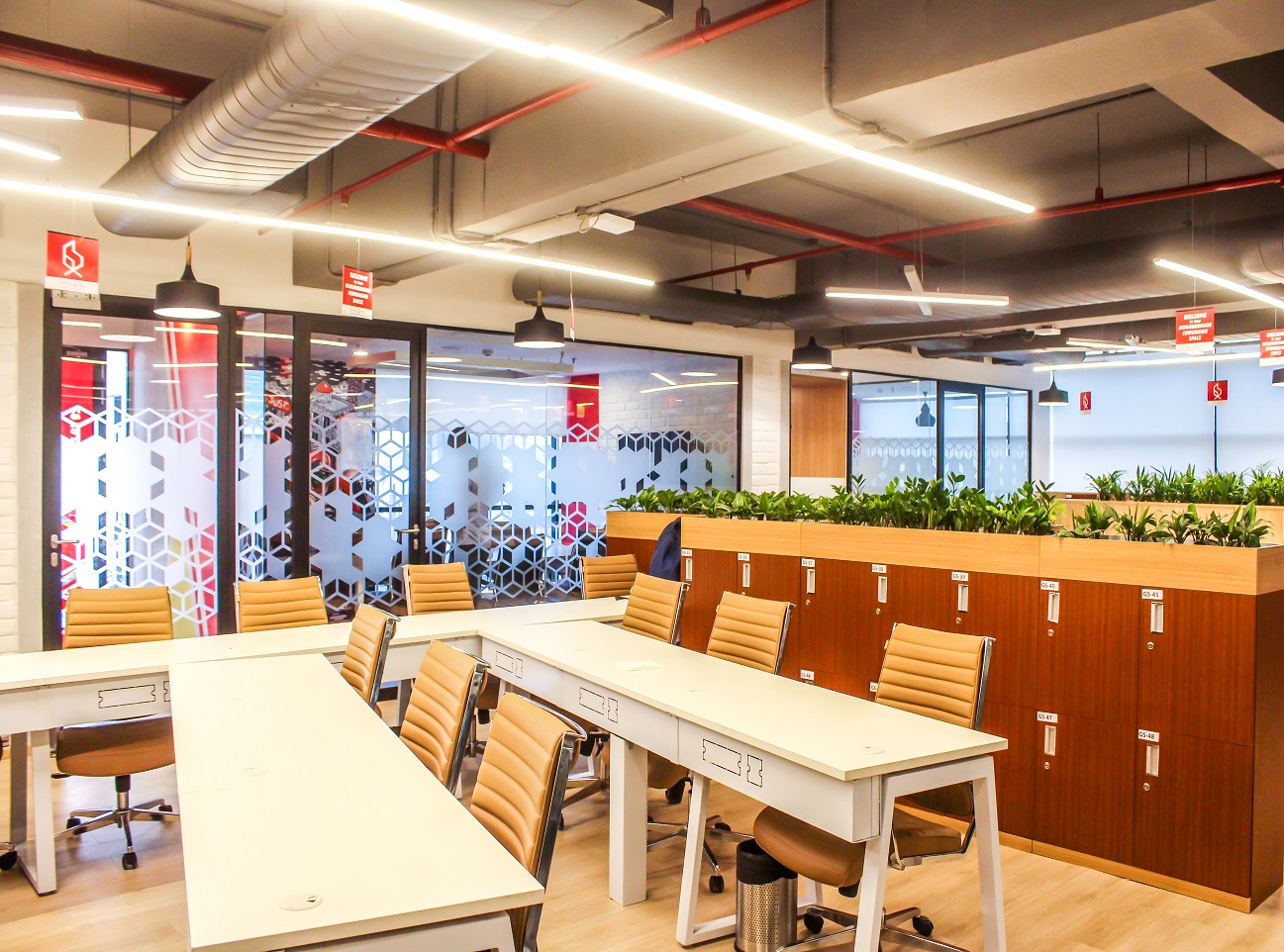
Managed offices are an ideal solution. This has many benefits. Instead of investing in setting up traditional leased offices, it allows you to have your own space at optimized costs. A managed office can be described as a blank space that can be leased out for medium to large durations and customized to complement your brand vision. This solution is easily adaptable and hence agile and simultaneously designed to improve the working experience. Some of the key ways it achieves this balance are:

  • Short lease periods help the company scale up and down as needed
  • Customized working spaces give employees the sense of working from an office space and boosts productivity
  • The ability to brand spaces maintains a professional appeal
  • Optimizing operational costs allows organizations to realign their budget towards measures needed to improve an employee’s experience
  • Decentralized workplaces reduce commute time for employees and hence improves their experience while maintaining work procedures

There are a number of managed office space providers. If your company chooses to go along this route, you must ensure that you sign a lease with a trust service provider. The Office Pass provides managed office spaces in Gurgaon, Noida and Delhi.

In addition to basic infrastructure and the ability to customize their space, The Office Pass offers easy, transparent leases without any of the obligations of traditional leases. To learn more, call now at 8999 828282.

BOOK A COWORKING TOUR

5 Reasons Why Large Companies & MNCs Favor Managed Offices

COVID Infections Counts Are Declining – Is It Time to Start Formal Work?

posted in: Coworking | 0

After a year of uncertainty, COVID numbers have finally begun to show signs of slowing down. The death rate, as well as the number of new cases per day is falling while the recovery rate is climbing. The trend has made many offices begin to question whether it may be time to reopen their office spaces and shift away from remote work. On one hand, we’re yearning to go back to the way things were and on the other, work from home may still be the safer option.

Should Companies Mandate Their Employees to Take COVID-19 Vaccine?

Advantages of Getting Back To Work from Office

Though there’s a lot that can be achieved by working from home, there’s a case to be made for getting back to the office as we once knew it. Let’s consider the 3 key factors in favor of restarting formal work.

Easier Collaboration

Work from home for individual tasks is great but when it comes to collaborative tasks or processes where individuals play different roles at various stages of the process, working remotely can be challenging. Even with emails and video calls, communication is stilted and processes can get slowed down. The quicker a company can get back to working from a common space post COVID, the smoother these processes can become.

Balanced Home-Work Life

Whether you look at it from the employee’s or the employer’s perspective neither is satisfied with the home-work balance when working from home. As an employer, until your team is at a place where their work can be monitored, managers will continue to feel that employees are using office time to complete day to day home tasks. On the other hand, employees feel that they are being forced to take on more tasks that eat into their family time.

Moving back to work from office mode will help redefine boundaries between home and office work. This helps satisfy employees and managers and improves the work-life balance.

Stronger Company Culture

Every organization wants loyal employees. Offering higher salaries alone may not be enough to achieve this. Organizations need to offer employees the right working experience. The ideal office culture is warm, friendly and helpful.

Building these bonds through a video or phone call is difficult. When new employees join the team, they need face-to-face meetings to build relationships. And, for this, you need a common office space.

Advantages of Waiting Just A Little While Longer

Patience is a virtue not just for individuals but also for organizations. When you’ve waited for long, waiting a few more months may be a better idea than hurrying to reopen office spaces. The three key reasons for this are:

Prioritized Employee Safety

As mentioned above, companies need to work hard to retain their employee’s loyalty. In addition to interpersonal relationships, they also need to show compassion and understanding for the employee’s health and safety.

In the current scenario, commuting to and from the office can put individuals as well as their families at risk. A single sick person at the office can infect many others. Thus, it may be prudent to let employees continue with remote work for another 6 months until the situation improves.

Maintained Productivity with Minimal Lags

It’s taken a while but employees have been able to find ways to be productive. We’ve overcome many of the challenges in our way and there’s a certain workflow that has been put into place. Shifting back to working from the office again will disrupt these procedures. Thus, productivity may slow down for a while.

Also Read: Should Companies Mandate Their Employees to Take COVID-19 Vaccine?

You also need to understand that with people commuting to work daily, there’s a risk they may fall ill and spread the infection to others. If this were to happen, tasks could come to a standstill and harm the company’s bottom line.

Minimized Operational Costs

One of the biggest advantages of working remotely is the reduced operational costs. With offices shut, utility costs such as electricity, heating, etc. are dramatically lowered. Getting people back to work is not as simple as just opening the doors.

Sanitization procedures at all entrances need to be implemented to protect employees. This is an added cost. In addition, utility costs such as electricity and air conditioning will once again jump high.

Within a year, hopefully, everyone will be vaccinated against COVID and the post COVID world will be much safer. The need for additional sanitization may be reduced and hence, businesses may be better positioned to optimize operational costs while ensuring employee safety.

Finding a Middle Ground

Everyone has their own opinions of whether to get back to working from their offices or not. At the moment there’s no clear winner. What is known is that we need to adapt once again and find a middle ground.

Some offices are bringing their employees back in phases with office days restricted to twice or thrice a week while others are only calling back those people who are essential. Another alternative would be to move away from traditional centralized offices to a network of managed offices spread across the city.

Managed offices are flexible, easy to scale and can be customized to match your company branding and vision. If you’re looking for such a managed office in Delhi, Noida or Gurgaon, contact The Office Pass (TOP) at 8999 828282.

BOOK A COWORKING TOUR

6 Reasons why coworking companies are growing rapidly post Covid

6 Reasons Why Coworking Companies Are Growing Rapidly In The Post COVID World

posted in: Coworking | 0

COVID hasn’t just changed the way we look at our health but also how we work. For almost a year now, we’ve been working remotely and managers have been forced to agree that work hasn’t come to a standstill because of it. It’s proof that not everyone needs to be in a formal office space to be productive. One of the effects is a rise in coworking office spaces. Even the most old-school companies are looking into options for a coworking space. After all, there’s no debate about its advantages.

6 Reasons why coworking companies are growing rapidly post Covid

  1. Easy To Scale & Flexible
  2. Prioritize Employee Safety
  3. Optimized Operational Costs
  4. Helps Expand Your Reach
  5. Helps Keep Your Private And Professional Lives Separate
  6. Sustainable Working Environments

1. Easy To Scale & Flexible

A coworking company offers shorter and more flexible leases. Coworking office spaces also allow companies to lease out just as much space as they require. This allows the companies leasing the space to be flexible as they scale up or down.

Companies don’t have to worry about blocking larger spaces when they don’t have enough people to fill them just so that they have space for future hires as and when the company grows. Instead, they can hire a space that’s enough for them at the moment and add more space only when it is needed.

2. Prioritize Employee Safety

Maintaining employee loyalty is about a lot more than just offering the right salary package. The post COVID office workspace needs to focus on improving the employee experience. A coworking space provider follows sanitization procedures to keep the space clean and hygienic as per MOH guidelines. It also plans seating arrangements that conform to physical distancing requirements while optimizing space usage. This allows workers to return to work confident that they aren’t compromising on their health by getting back to the office space. Coworking companies are much safer than traditional offices in the post COVID world.

3. Optimized Operational Costs

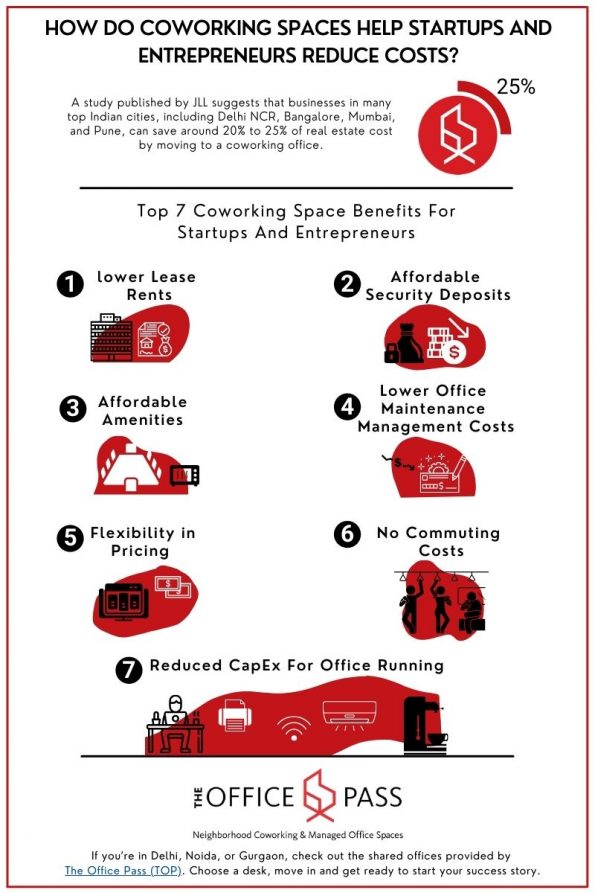
One of the main reasons leasing space from a coworking company seems more beneficial as compared to traditional leased spaces is because of the way it helps optimize operational costs. The coworking company like The Office Pass (TOP) in Delhi NCR region, takes care of all operational and admin costs such as housekeeping, air conditioning, security, printing, tea & coffee etc.

When it comes to returning to post COVID office work, companies also have to consider sanitization protocols. Since maintaining these protocols is taken care of by the space provider, companies can offer their employees a safe space to work in without any additional expenses.

4. Helps Expand Your Reach

Instead of investing in a single large office space for everyone, companies can set up smaller but distributed coworking spaces at multiple locations that are more easily accessible to employees. This is beneficial for employees and the employer. For employees, this means reduced commute time as they are able to operate from a Coworking space close to their place of residence. For the employer, this helps reach out to a wider talent pool. It also helps in retaining employees as they are able to strike a decent work-life balance.

A potential employee’s location is no longer one of the factors determining their employability. They can now hire people from anyone and set them up to work near home.

5. Helps Keep Your Private And Professional Lives Separate

One of the most common challenges faced by people when working remotely has been the blurred lines between personal and professional time. What begins as multitasking can lead to reduced productivity on both fronts. This can be frustrating for the employer and the employee.

For all the comforts associated with working from home, it lacks a professional aura. At the same time, the convenience offered often makes it beneficial as compared to getting back to a central office space.

A managed office helps redraw these lines while maintaining the advantages of both scenarios. The offices are closer and hence employees do not have to travel far and space can be designed according to the company branding to maintain a professional look.

Holding meetings in coworking spaces is much more professional than meetings in coffee shops and helps the brand maintain its look and create good impressions on clients, investors and partners alike.

6. Sustainable Working Environments

Sustainability is a buzzword that has been gaining global traction over the past few years. Leasing coworking spaces rather than investing in a central office space helps companies dramatically lower their carbon footprint. Everything from electricity consumption to emissions from HVAC systems is lowered.

Finding A Coworking Company That Is Right For Your Post COVID Office Work

In 2019, the global coworking spaces market was valued at $9.27 billion. The valuation dropped due to COVID to $8.24 billion in 2020 but is expected to recover and reach $11.52 billion by 2023. Thus, as expected, companies wanting to lease coworking spaces have no dearth of choices.

That said, not all coworking spaces are the same. A managed office is a hybrid between traditional centralized office spaces and coworking spaces. It offers all the conveniences and benefits of both worlds.

Managed offices can be leased for shorter periods than traditional offices but need not be on a day-to-day basis. Hence, it offers stability. The leases are transparent and space can be expended whenever needed to maintain flexibility for growth.

With a managed office, companies can also brand their spaces. From wall color schemes to furniture layouts, customization helps them maintain the look and feel they want to project. At the same time, resources like printers, kitchens, etc. are common to all the companies using the space and hence operational costs are lowered and sustainability is improved.

If your company is looking for coworking office space in Delhi, Noida or Gurgaon, take a look at the services offered by The Office Pass. For more information, call us at 8999 828282.

BOOK A COWORKING TOUR

Top 5 Hiring Challenges From A Coworking Space & How To Handle Them

Can Work From Home Take Away Your Competitive Intensity?

posted in: Work From Home | 0

The COVID pandemic proved that almost everyone can work from home. Offices have stayed closed for months now and yet work hasn’t come to a stop. Remote working is trendy now and many companies and employees are contemplating its sustainability.

The option has benefits for everyone – lower operational costs for the employers and greater flexibility for the employees. But, working from home does have its challenges. Could it be the reason you lose out on your competitive edge?

Networking becomes harder

When you go out for work, you meet a number of people throughout the day – your colleagues, people from other agencies and offices, fellow commuters and so on. These meetings are important not just for the social exercise they provide but also for networking. Chances are when you were job-hunting, you were introduced to positions by some of these people.

When you work from home, you miss out on this networking. Your social interactions are limited to family, friends and your existing colleagues. You don’t meet people in the lift going to your office, you don’t bump into people in the lobby… Thus, if you’re on the lookout for a new position, you’ll have to rely on networking websites.

You might miss out on company news

There’s a lot you learn about your company and your team through random conversations over lunch or when someone stops by your table. You might consider them distractions but these chance encounters can tell you when a new position opens up that you might be well suited to or when someone else has a project that could use your expertise.

On the other hand, working from home means no distractions to your work atmosphere. The people stopping by your table won’t have any connection to your company and the news they share will probably not have much to do with your career growth.

There’s no external motivation

When your office celebrates an achievement- yours or anyone else’s, you get motivated to work harder. When you see someone getting promoted, you get motivated to work towards such a promotion too. When you’re feeling unproductive and distracted at work, your manager can sense it and help you overcome the hurdles. For people who need external motivation, the work atmosphere is critical to their productivity.

When you’re working remotely, all you have to push you through the day is your to-do list and your ability to push yourself. If you don’t feel particularly driven in the morning, you might not be able to complete your to-do list. The blurred lines dividing your home and work life can also affect your work intensity. Now, you can’t leave your home troubles at home. You work there too!

Also Read: 8 Things Employers Can Do to Increase Employee Productivity

Learning must be self-driven

One of the ways people assess companies is by the effort they make in training and upskilling their employees. If you work in a company that invests in its employees, your workweek would probably be punctuated with workshops and training modules. This helps you stay up to date with your skills, encourages you to learn and helps build a competitive edge. It’s important because after a certain stage, putting yourself in a position to learn can be challenging.

When you’re working from home, everything is in your hands. The company can give you access to virtual classroom links but there’s nobody to ensure that you attend them and learn from them. You might think you’re being smart by multitasking while you’re ‘attending’ a workshop but if you don’t pay attention, you’ll lose out.

In short, when you’re working remotely, any kind of learning has to be self-driven.

Productivity expectations may not always match

The work atmosphere at home and in the office is very different. At the office, you can consider people stopping by your table and meetings as distractions. This can make you believe that working from home, free of these distractions, will let you get a lot more done in the day.

But, it isn’t necessarily so.

You may assume that without any such distractions and since you don’t have to commute you will have more time at your disposal. Thus, you may set high targets for yourself. But, no one can work continuously throughout the day. Instead of short breaks for coffee, you might end up taking longer breaks and thus your productivity may not always match your expectations. Over time, this can lead to complacency and affect your competitive spirit.

Finding a middle path

Getting back to work in a formal atmosphere may have its advantages for your competitive edge but working from home has its advantages too. So, you need to find a middle path. This is where managed offices come in. This hybrid solution offers an ideal work atmosphere that pushes you to work harder while giving you the flexibility to match your work timings to your schedule and reducing your commute time.

If you’re looking for a managed office in Delhi, Noida or Gurgaon, The Office Pass (TOP) may have just the solution you need. These spaces are easy for companies to lease out for short periods. It also permits office spaces to be customized as per the company branding. Interested? Call 8999 828282 to learn more.

BOOK A COWORKING TOUR